A metal shim can close a dimensional gap and still leave a poor thermal interface. Thickness, seating and contact pressure are separate parts of the design.
A precision shim is useful when an assembly needs a controlled spacing or height adjustment. Photo etching can be considered when that shim also needs a complex outline, clearance openings or repeated fine features. Its thermal value depends on how the finished assembly makes contact, not just on the conductivity of the shim material.

First decide whether the shim is spacing or conducting
Some shims position a component while a separate interface material carries heat. Others form part of the intended heat path. A locating shim may only need to maintain geometry; a heat-path shim must also be assessed at its two interfaces.
For a uniform solid layer, the simple conduction relationship is resistance proportional to thickness and inversely proportional to conductivity and area. That relationship describes the layer itself. It does not include the contact resistance at either face, and it does not mean every nominal square millimeter is making good contact.
A nominal thickness is not the whole gap budget
Consider the mating components, their surface form and their assembly restraint together. Adding several thin shims may provide a convenient height adjustment, but it also adds interfaces and handling steps. A single purpose-made thickness may simplify the stack once the required height is known.
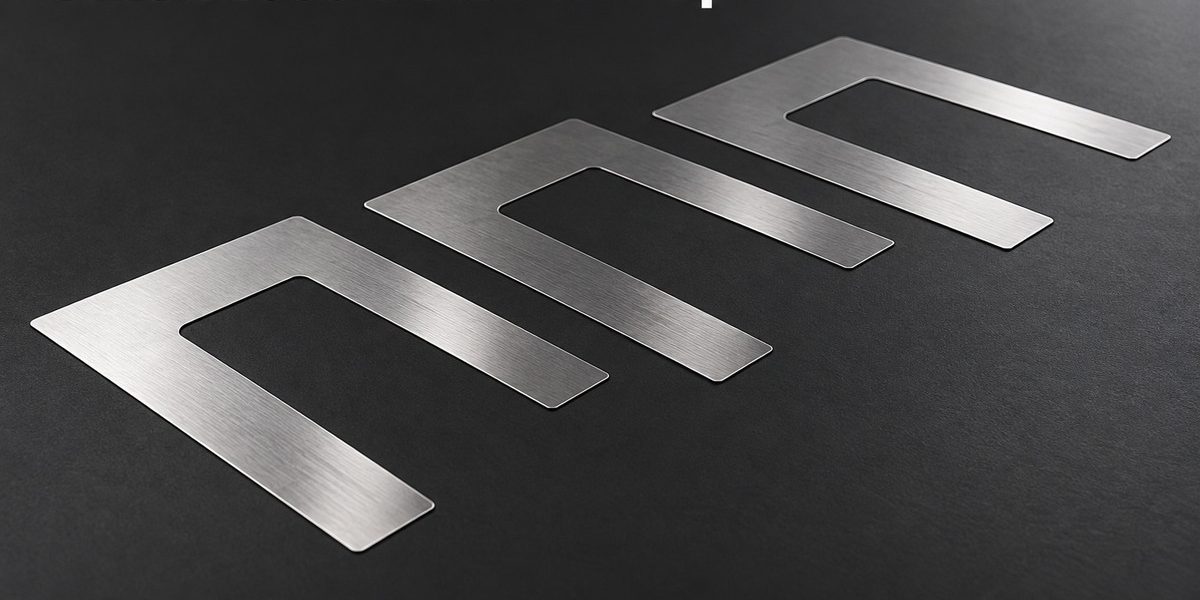
Openings and narrow necks can make the part easier to fit around nearby features. They also change how it is supported and where force is transferred. An elegant outline is useful only if the part can be seated without rocking, creasing or bridging the region that needs contact.
Why thin electronics make this a practical issue
Compact thermal packaging remains a live design topic: Apple’s September 9, 2026 announcement describes a redesigned vapor chamber. That news does not specify the use of etched shims. It does illustrate why designers keep revisiting the small mechanical interfaces around cooling hardware.
For a new shim design, a controlled assembly comparison is more informative than comparing loose sheets by touch. Keep the mating surfaces and clamp condition consistent, then examine whether the proposed thickness produces the intended seating. Evaluate temperature behavior on the assembled system when the shim participates in the heat path.
Where etching belongs in the decision
A simple open washer may suit another cutting process economically. A delicate flat shim with many clearance details is a more relevant etching discussion. XINKETCHING can review the proposed sheet geometry; the drawing should state both the spacing function and the surfaces that must remain in contact.
Related engineering reading: metal etching process and DFM guide; thin thermal layers; thin-sheet flatness.
References: Apple, iPhone 18 Pro and iPhone 18 Pro Max announcement (2026-09-09); NASA Technical Reports Server, Thermal Contact Resistance in a Non-Ideal Joint (1973; accessed 2026-09-16).

- What Can a Pilot Lot Actually Prove About Etched-Part Repeatability? - October 9, 2026
- How Much Open Area Remains After an Acoustic Mesh Is Assembled? - October 8, 2026
- How Do You Compare Etched Prototypes Without Losing Track of the Design? - October 7, 2026