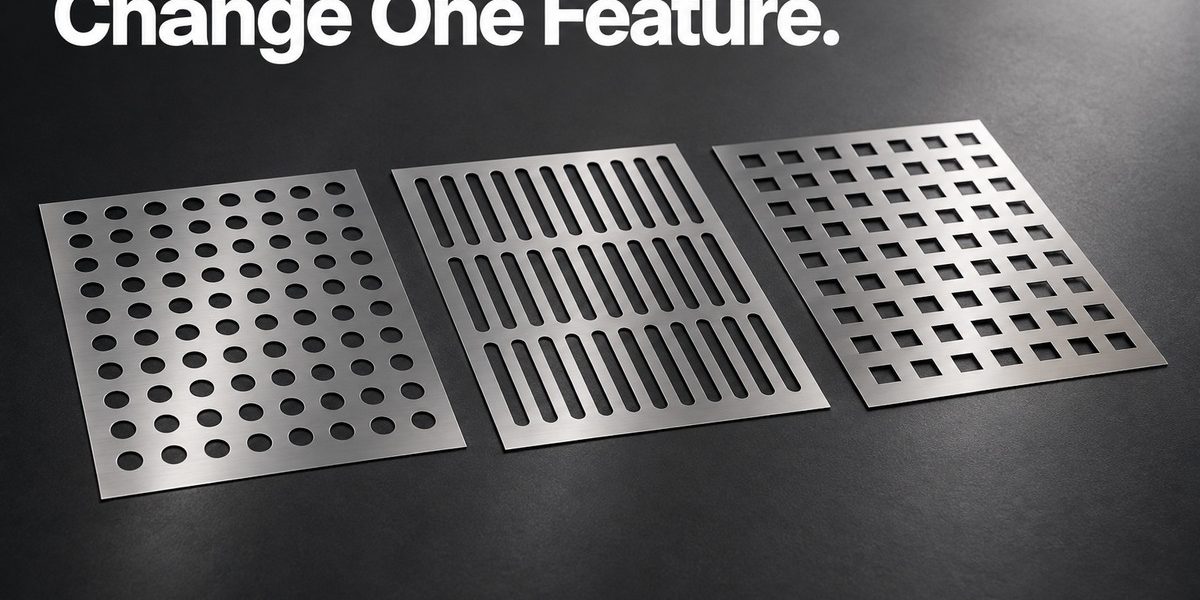
Three prototype versions arrive in one tray. The newest has a wider slot, another has a different coating, and someone has changed the mounting condition. One performs better. What, exactly, has been learned?
Photo etching makes pattern changes practical because the geometry is defined through tooling artwork rather than a new hard stamping die for every revision. That flexibility is valuable only if the physical samples remain connected to the design question being tested.

Give each variant a question
A comparison might ask whether a different slot pattern clears a mating feature while retaining enough support. Keep the alloy, thickness and surrounding outline consistent when those variables are not part of the question. If the coating must change too, record it as a separate factor rather than treating the new sample as a simple slot revision.
The aim is not to prohibit experiments with several variables. It is to distinguish an intentionally designed comparison from an accidental mixture of changes. A deliberately planned multi-factor experiment can be useful; a tray with missing revision labels cannot.
The drawing and the sample need to agree
Use a stable part identifier and an explicit revision for each released design. Keep the CAD file and dimensioned drawing at the same revision. A supplier receiving a newer CAD file with an older acceptance drawing has two competing definitions of the part.
After manufacturing, keep the sample label, material record and measurement results together. If parts are too small for individual marking, identify the carrier or container and maintain separation through testing. A photograph can help with identification, but it should not replace the revision record when similar variants look alike.
Write down what would change the decision
Before the samples arrive, decide which outcome would favor a variant. That could be a clearance measurement, an assembly behavior or a functional result. Defining it early reduces the temptation to select whichever result looks most flattering after the test.
Siemens’ September 11, 2026 discussion of verification traceability concerns modern systems development. The relevant principle here is the link between a requirement, a design revision and the evidence used to judge it. A sample becomes useful evidence when that link is preserved.
For a XINKETCHING prototype comparison, a short variant table can accompany the drawings: revision, changed feature and evaluation question. It gives the etching team a clear basis for preparing the right samples and gives the customer a result that can support the next design decision.
The benefit of fast iteration is not simply obtaining another version quickly. It is being able to explain why the next version should be different.
Related engineering reading: metal etching process and DFM guide; carrier-sheet delivery.
References: Siemens, Why Verification Traceability Must Evolve for Modern Systems (2026-09-11).

- What Can a Pilot Lot Actually Prove About Etched-Part Repeatability? - October 9, 2026
- How Much Open Area Remains After an Acoustic Mesh Is Assembled? - October 8, 2026
- How Do You Compare Etched Prototypes Without Losing Track of the Design? - October 7, 2026