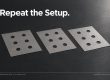
A mesh may have a generous open area on its drawing and a much smaller working area once adhesive and housing ribs sit behind it. The sound path belongs to the assembly, not to the metal sheet alone.
For an acoustic grille, distinguish the percentage of openings within the patterned metal from the area actually exposed in the finished product. Both are useful, but neither by itself establishes acoustic transparency, frequency response or protection against water and dust.

The percentage needs a defined boundary
For a repeating pattern of circular holes on a square pitch, the ideal patterned-region open-area fraction is πd²/(4p²), where d is hole diameter and p is center-to-center pitch. This calculation excludes solid borders and assumes the stated ideal geometry. Other patterns require a different area calculation.
Now add a solid perimeter, an adhesive ring and a housing aperture. Only the holes overlapping the exposed assembly window contribute to that window’s open area. The patterned-region percentage has not changed, but it no longer describes the entire component or the assembled sound path.
Smaller holes solve one problem and may create another
A fine pattern can provide a more uniform visual surface and help manage access to the components behind it. Reducing hole size at fixed pitch removes open area; reducing pitch as well changes the remaining metal between openings. Thickness and aperture profile also affect the passage through the sheet.
For acoustics, the metal is only one layer. Adhesives, protective fabrics, membranes and the cavity behind the grille can change the response. A beautiful metal sample is therefore a useful appearance prototype, but the acoustic comparison belongs in a representative assembly.
Keep the mounting details visible in the design review
An overlay of mesh, adhesive and housing is often more informative than three separate drawings. It reveals whether a rib sits behind a perforated region and whether assembly tolerance could move an adhesive edge into the active window.
Apple’s September 11, 2026 product-availability update includes AirPods 5. It is a current audio-product reference, not a disclosure of its grille construction. The manufacturing discussion here applies to independently designed acoustic meshes and microphone grilles.
For XINKETCHING, show the desired appearance together with the exposed window and the attachment region. That allows an etched pattern to be considered as part of a real assembly. The final acoustic result should be evaluated with the other sound-path layers in place.
A useful mesh design leaves the right area open after assembly—not just before it.
Related engineering reading: metal etching process and DFM guide; microhole measurement.
References: Apple, iPhone 18 Pro, Apple Watch and AirPods 5 availability update (2026-09-11); Precision Micro, Photo Etched Speaker Grilles: A Sound Approach (accessed 2026-09-16).

- What Can a Pilot Lot Actually Prove About Etched-Part Repeatability? - October 9, 2026
- How Much Open Area Remains After an Acoustic Mesh Is Assembled? - October 8, 2026
- How Do You Compare Etched Prototypes Without Losing Track of the Design? - October 7, 2026