A tiny metal part that is easy to pick up as a CAD model can be awkward to handle as a loose foil. It can turn over, catch on another part or bend before assembly begins. Sometimes the useful item to purchase is a carrier of parts, not a bag of individual pieces.
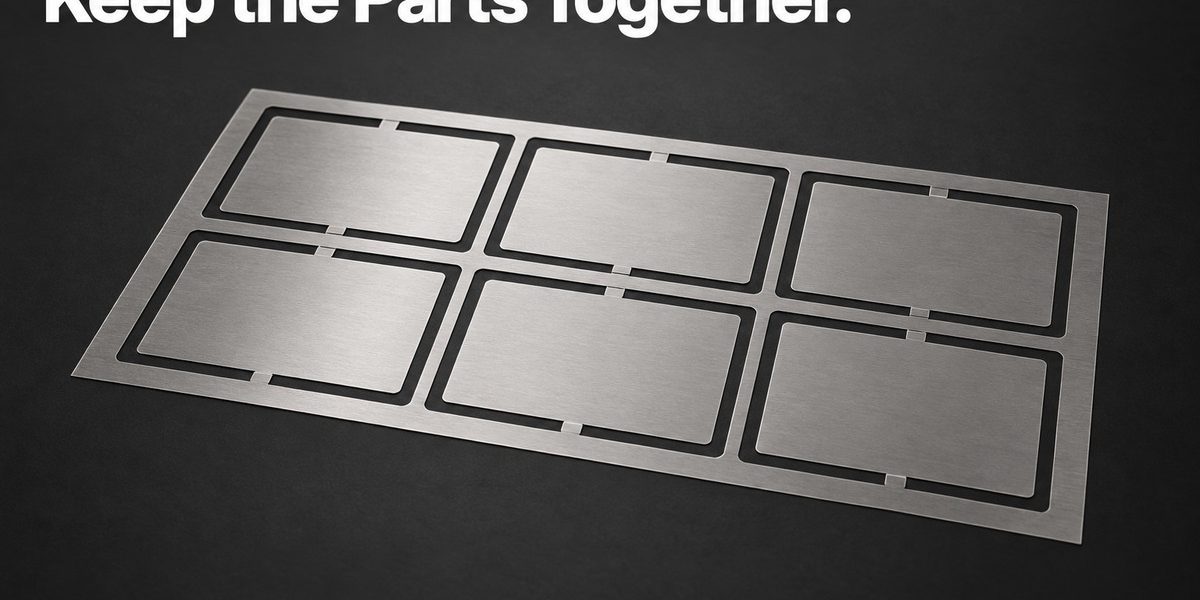
Etched parts can be retained in a sheet by small metal tabs, subject to the geometry and manufacturing route. A carrier can simplify handling and preserve orientation. Loose parts avoid a later separation step. The better choice depends on what happens after etching.

Follow the part to the next workstation
If parts go directly into individual fixtures, a loose supply may be convenient. If they undergo another batch operation or need a controlled orientation, retaining them in a frame may reduce handling. The carrier is then part of the production method, even though it is absent from the finished product.
Precision Micro’s technical explanation of etch tags describes their role in retaining components through manufacture and subsequent operations. It also distinguishes protruding and recessed tag arrangements. These are useful concepts for discussing a design; the supplier’s own tolerances and process claims are not XINKETCHING specifications.
The tab location should have a practical reason. A tab at a functional seating edge creates a different problem from a tab in a clearance region. Removal can leave a local profile condition that must be acceptable or addressed by a subsequent operation. “Supplied loose” should therefore include an understanding of how the parts are separated.
Use the carrier to keep information attached
A frame also gives the batch somewhere to carry identification without marking every delicate component. Keep the material and revision associated with that frame through the handoff. Once several visually similar versions are separated into one tray, the convenience of a shared container can become an identification problem.
Siemens’ September 15, 2026 update on nonconformance management emphasizes traceable manufacturing records in semiconductor production. The scale and process differ, but the relevant thin-metal principle is straightforward: retain the connection between a physical sample and the record describing it.
Choose the separation point deliberately
Decide who removes the parts, when removal occurs and what condition the released edge must meet. A sample carrier can reveal handling difficulties that are invisible in an individual-part drawing.
For XINKETCHING, the useful drawing discussion includes both the finished part and the next operation. A carrier should earn its place by making that operation more reliable. If it merely shifts an awkward task to the customer, a different delivery format may be the better choice.
Related engineering reading: metal etching process and DFM guide; thin-sheet flatness.
References: Precision Micro, Etch Tags: What Are They and Why Are They Important? (accessed 2026-09-16); Siemens, Expanded Nonconformance Management for Semiconductor Manufacturing (2026-09-15).

- What Can a Pilot Lot Actually Prove About Etched-Part Repeatability? - October 9, 2026
- How Much Open Area Remains After an Acoustic Mesh Is Assembled? - October 8, 2026
- How Do You Compare Etched Prototypes Without Losing Track of the Design? - October 7, 2026