Direct answer: yes. Photochemical etching can produce dense repeated holes and slots in thin titanium sheet, making it a strong candidate for certain foldable-display support plates and reinforcement structures. The process is most attractive when the component is primarily flat, contains many repeated openings, and must avoid stamping burrs or laser heat input.

The important question is not whether “micro holes” are possible in general. It is whether the material thickness, hole size, pitch, web width and tolerance work together.
Why this question matters in foldable displays
Samsung’s 2026 Flex Titanium announcement describes a titanium plate beneath the foldable display and specifically says that micro-patterned holes in the folding section help the plate retain flexibility while providing structural support. Samsung does not identify photochemical etching as the manufacturing method, so no process or supplier relationship should be assumed. The announcement is still important because it shows that dense precision hole patterns are now a real structural design feature in commercial foldable displays.
Source: Samsung Global Newsroom — Flex Titanium technology
Why photo etching is efficient for dense hole patterns
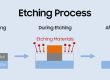
In photochemical machining, the complete hole pattern is transferred to photoresist and etched across the sheet. A design with 20 holes and a design with 2,000 holes do not require a cutting tool to visit each hole sequentially. That is one reason the process works well for precision screens, perforated plates, meshes and thin support structures.
- No mechanical punching burr.
- No localized laser heat-affected zone.
- No hard stamping die for early design revisions.
- Complex hole arrays can be processed together.
- Through holes and selected half-etched features can be combined in one design when DFM permits.
DFM variables that control the result
| Variable | Why it matters |
|---|---|
| Titanium thickness | Thicker sheet generally requires larger minimum features and wider webs. |
| Hole / slot size | As openings become very small relative to thickness, lateral etching has a greater effect on final size. |
| Pitch | Pitch controls the remaining ligament between openings and therefore both strength and process stability. |
| Web width | Very narrow webs can become fragile or dimensionally unstable. |
| Critical tolerance | Tolerances should be assigned to functional dimensions rather than applied equally to every feature. |
| Flatness / bonding surface | Display-support parts may require surface and flatness controls beyond simple XY dimensions. |
A practical starting rule
For early DFM, XINKETCHING normally prefers the minimum hole or slot dimension to be at least around the material thickness. This is a starting guideline, not a universal limit. Finer geometry can sometimes be produced, but it should be reviewed from the actual CAD drawing rather than promised from a generic table.
For example, a 0.10 mm titanium plate with 0.10–0.20 mm openings is a very different manufacturing problem from a 0.50 mm plate with the same openings.
When another process may be better
Photochemical etching is not the correct process for every titanium hinge component. Thick 3D hinge bodies, deep structural ribs and load-bearing forms are typically better suited to machining, forging, MIM or additive manufacturing. OPPO’s Find N6, for example, publicly describes Grade 5 titanium hinge casing and wing plates produced with a 3D printing process.
Source: OPPO Global — Find N6 foldable engineering
What to send for a feasibility review
- DXF/DWG plus a dimensioned PDF.
- Titanium grade and material thickness.
- Minimum opening and minimum web width.
- Critical pitch and positional tolerance.
- Quantity and prototype requirement.
- Any flatness, cleaning, surface treatment or bonding requirements.
See the main XINKETCHING foldable phone metal etching guide for the full process-selection framework, or review our titanium etching capability.
Need a DFM answer? Send the drawing to sales@xinketching.com.

- Micro-Patterned Titanium Holes for Foldable Displays - September 12, 2026
- Chemical Concentration Calculator - August 2, 2026
- Etching Cost Calculator - June 14, 2026