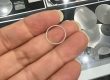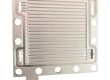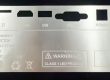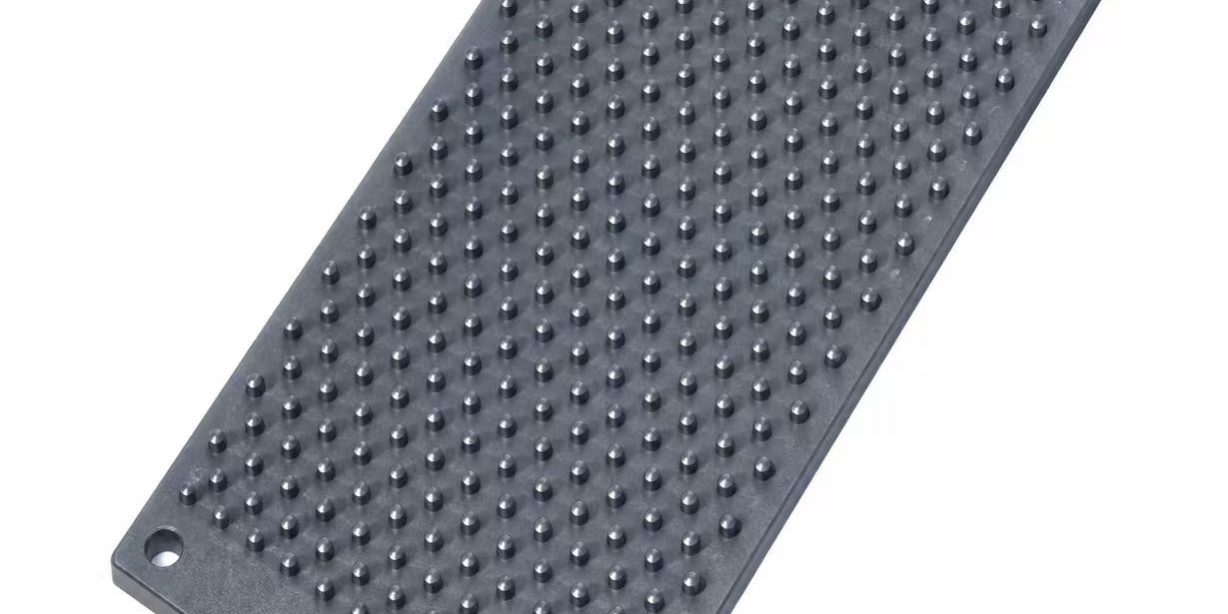
Half-etching is the part of the etching process most drawings underuse. Xinketching is a precision photochemical etching manufacturer in Dongguan, China, producing flat etched metal parts since 2005. In a single chemical pass we can cut some features all the way through the sheet while etching others only part-way down — to roughly 50–75% of the material thickness, with depth control of ±0.05 mm. That second, partial depth is what turns a flat outline into a functional part: flow channels in a cold plate, fold lines in a shield can, a recessed seat, or a permanent logo etched into the metal itself. No second operation, no extra tooling, no added lead time.
Answer capsule: what is half-etching for?
- Channels and recesses — flow paths for liquid-cooling plates, gasket seats, pockets that locate or nest another component.
- Fold lines — a half-etched groove along a bend line makes a flat etched blank fold accurately by hand or with simple tooling, with the groove, not a guess, setting the bend position.
- Marks that cannot wear off — logos, part numbers and orientation marks etched into the surface in the same pass; they are part of the metal, not ink, print or a label.
- Weight and stiffness tuning — thinning selected areas of a part without changing its outline or its mounting faces.
Specifications
- Half-etch depth: ≈50–75% of material thickness (e.g. 0.10–0.15 mm deep in 0.2 mm stock; 0.25–0.38 mm deep in 0.5 mm stock)
- Depth control: ±0.05 mm
- Through-features in the same pass: holes and slots at least roughly the material thickness (design rule ≈ 0.8–1.2× thickness)
- Dimensional tolerance (through-cut geometry): ±10% of material thickness (e.g. ±0.02 mm on 0.2 mm stock, ±0.03 mm on 0.3 mm stock); raw-stock thickness tolerance ±0.02 mm
- Thickness range: 0.05–2.5 mm — gauges 0.05, 0.08, 0.1, 0.12, 0.15, 0.2, 0.25, 0.3, 0.4 and 0.5 mm are stocked; above 0.5 mm up to 2.5 mm is sourced per order
- Format: flat sheets only, no coil/reel-to-reel; maximum single sheet 600 × 14,500 mm for material 0.5 mm and above
- Finishing: passivation in-house; plating and other surface treatment via qualified partners where the drawing calls for it
- Lead times and order terms: samples 3–5 days, production 7–10 days; no minimum order quantity, minimum order charge US$100; FOB
- Quality documents: material test certificate with per-run material batch traceability; PPAP Level 3 supported; IMDS data available; NDAs on request
How it works, in one pass
Photochemical etching exposes the sheet through a photoresist pattern, then dissolves the unprotected metal. A through-feature is exposed and etched from both sides until the metal is cut through. A half-etched feature is worked so the etchant removes only part of the thickness before the process stops. Because both depths come from the same artwork, the half-etched channel, groove or logo is registered to the through-cut outline by the pattern itself — there is no second setup to drift out of alignment. That registration is why a half-etched fold line lands exactly on the drawn bend position, and why an etched logo never sits a millimetre off from batch to batch.
The depth window, and why it stops at 75%
The honest working window is ≈50–75% of thickness, controlled to ±0.05 mm. Shallower than about half depth, a feature becomes hard to distinguish from surface finish variation and loses its function — a fold line that does not guide the bend, a channel that does not carry the flow. Deeper than about three-quarters, the remaining ligament gets fragile and the depth variation (±0.05 mm) becomes a large fraction of what is left, so strength and depth both stop being predictable. Worked examples:
- 0.2 mm stock → half-etch 0.10–0.15 mm deep, leaving 0.05–0.10 mm of metal — fine for logos, shallow seats and fold lines
- 0.5 mm stock → half-etch 0.25–0.38 mm deep, leaving 0.12–0.25 mm — the territory of liquid-cooling flow channels
- 1.0 mm stock → half-etch 0.50–0.75 mm deep — deeper channels and pockets, from per-order material
If a drawing needs a machined-depth pocket with machining tolerances, say so plainly: that is a machining job, and we will tell you at quotation rather than stretch the etch window to pretend otherwise.
Fold lines: the application designers ask about most
A shield can, clip or bracket that must be bent after etching bends where the metal is weakest. A half-etched groove along the bend line makes that place the groove — at a controlled depth, on the drawn line, on every part in the batch. Two drawing notes matter: put the groove on the inside of the bend unless the design says otherwise, and remember bending/forming itself is a separate downstream step (ours is carried out with qualified partners) — the etched groove makes it accurate and repeatable, it does not remove the step. Groove depth near the deeper end of the window suits parts bent once to a fixed angle; shallower grooves suit parts that may be adjusted in assembly.
Etched logos and marks
A half-etched logo or part number is cut into the metal in the same pass as the part itself: no ink to fade, no label to peel, no laser setup, and no added cost per mark once the artwork carries it. Depth around the middle of the window reads clearly under normal light while keeping the surface easy to clean. For branded parts this has a practical edge beyond appearance — a mark that is part of the metal cannot be copied by reprinting a label, and it survives the service life of the part.
When is half-etching the wrong answer?
When the feature needs to be deeper than ~75% of a workable gauge, when its depth must be held tighter than ±0.05 mm, or when the “channel” is really a three-dimensional machined manifold. Half-etching is a flat-sheet process: it makes channels, grooves, recesses and marks in 0.05–2.5 mm flat parts, and we do not etch aluminium. Inside that window it is usually the cheapest functional feature on the drawing, because it arrives free with the through-cut.
FAQ
Does half-etching cost extra or add lead time?
No separate operation is involved — half-etched features are produced in the same pass as the through-cut, inside the standard lead times (samples 3–5 days, production 7–10 days). What we need is the feature drawn or specified, with its target depth.
How deep can a half-etched channel be?
About 50–75% of the sheet thickness, held to ±0.05 mm. On 0.5 mm stock that is a 0.25–0.38 mm deep channel. Tell us the depth the function needs and we will confirm the gauge that carries it.
Can a logo be etched into a part at no extra process step?
Yes — logos, part numbers and orientation marks are half-etched from the same artwork in the same pass. They are part of the metal itself, so they do not fade, peel or wash off.
Which side of the sheet is half-etched?
Either — state the side on the drawing. Fold-line grooves normally sit on the inside of the bend; channels and marks sit on the functional face. If the side is not specified, we will ask at quotation rather than guess.
CTA: Send your drawing to sales@xinketching.com — Xinketching, Dongguan · since 2005 · xinketching.com

- Photo Etching Tolerances: Why ±10% of Material Thickness Is the Honest Number - October 29, 2026
- Designing Etched Metal Mesh: Aperture, Pitch and Open Area - October 28, 2026
- Half-Etching Explained: Channels, Fold Lines and Logos at 50–75% Depth - October 27, 2026