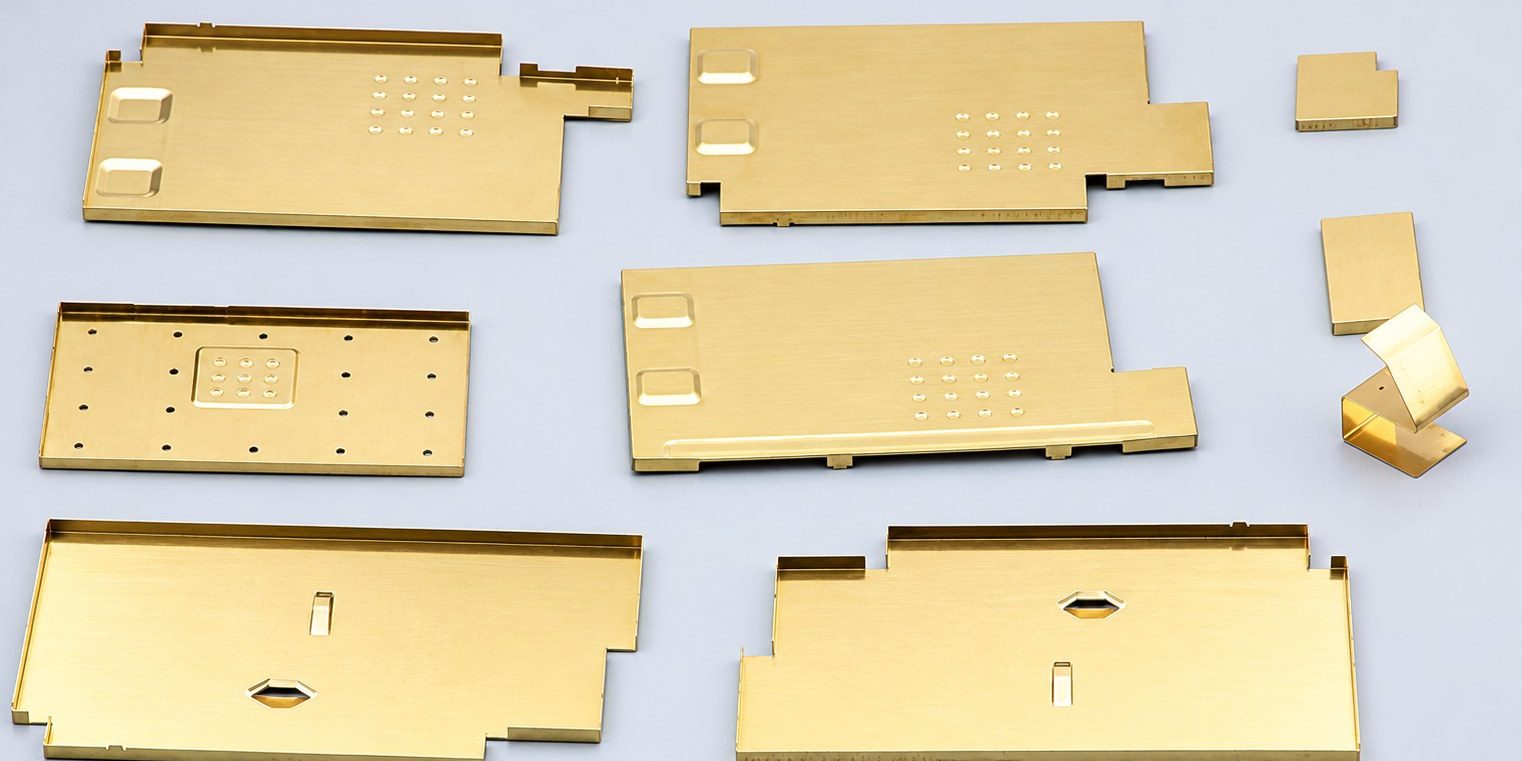
An etched-part quotation has no tooling line, no die amortisation and no minimum quantity to hide behind — which makes it unusually readable, once you know what to look for. Xinketching is a precision photochemical etching manufacturer in Dongguan, China, producing flat etched metal parts since 2005. This guide explains what a quotation is built from, what moves the price, and how to compare two quotations fairly.
Answer capsule: what a quotation is built from
- The drawing package. Pattern, material and grade, thickness, critical dimensions, finish, quantity and application — the same package our buyer’s guide asks for.
- Material and thickness. Grade, gauge and whether the gauge is stocked (0.05–0.5 mm) or sourced per order (above 0.5 mm to 2.5 mm).
- Feature complexity. Fine features, tight tolerance callouts, half-etched depths, and how many parts nest on one sheet.
- Finish and secondary work. Passivation in-house; plating through qualified partners; spot welding in-house; other secondary operations outsourced and quoted with the part.
- Documents. Material test certificate with batch traceability is standard; PPAP Level 3 and IMDS data are available on request.
- The commercial baseline. Samples in 3–5 days, production in 7–10 days, no minimum order quantity, a US$100 minimum order charge, FOB.
Specifications
- Materials: stainless steel, copper, brass, nickel, titanium (we do not etch aluminium)
- Thickness range: 0.05–2.5 mm — gauges 0.05, 0.08, 0.1, 0.12, 0.15, 0.2, 0.25, 0.3, 0.4 and 0.5 mm are stocked; above 0.5 mm up to 2.5 mm is sourced per order
- Dimensional tolerance: ±10% of material thickness; raw-stock thickness tolerance ±0.02 mm
- Minimum through-features: ≈ material thickness (design rule ≈ 0.8–1.2× thickness)
- Half-etched features: ≈50–75% of thickness, depth control ±0.05 mm
- Format: flat sheets only, no coil/reel-to-reel; maximum single sheet 600 × 1,450 mm for material 0.5 mm and above
- Finishing: passivation and mesh spot welding in-house; plating via qualified partners
- Lead times and order terms: samples 3–5 days, production 7–10 days; no minimum order quantity, minimum order charge US$100; FOB
- Quality documents: material test certificate with per-run material batch traceability; PPAP Level 3 supported; IMDS data available; NDAs on request
What moves the price, in order of weight
Material first. Grade and gauge dominate: a 316 part costs more than a 304 part because of the molybdenum and nickel in it, and a gauge above 0.5 mm is sourced per order rather than drawn from stock. Specifying 316 where 304 survives, or a thick gauge where a thin one works, is the most common way buyers pay for nothing — our post on 301 vs 304 vs 316 shows where each grade earns its premium and where it does not.
Feature complexity second. Fine apertures, dense patterns, half-etched depths that must be held to ±0.05 mm, and tight tolerance callouts all add process attention. Complexity is not a penalty for its own sake — it is the reason etching exists — but a drawing with ten critical dimensions costs more to control than a drawing with two, and a quotation should reflect that honestly.
Panelisation third. Parts nest on flat sheets, and how many fit on one sheet — with the outline, the handling margin and the sheet size limit — sets the material usage per part. A small part that nests densely quotes differently from a large part that fills a sheet alone, even in the same material.
Finish and secondary work fourth. Passivation is part of the standard stainless flow. Plating specifications, spot-welded assemblies and outsourced secondary operations are quoted with the part and named separately, so the buyer can see what each step costs rather than finding it buried in a unit price.
Quantity fifth — but without a cliff. Because there is no tooling to amortise, the price curve from prototype to production is smooth: it moves with material and machine time, not with a tooling charge disappearing at some volume threshold. A 100-piece order and a 100,000-piece order are priced on the same basis, which is why a small first order is a fair test of the production price.
Sampling and production: one process, one price basis
Samples ship in 3–5 days and production in 7–10 days, on the same chemistry, artwork discipline and tolerance rules. That matters for quotation comparisons: a sample that passed validation was made the way production will be made, so the production price is not a different process wearing the sample’s name. And because a design change is an artwork change, a revised sample runs the same 3–5 days — revision cost is measured in days, not in retooling.
How to compare two quotations fairly
Line up the same basis before comparing numbers. Same material and grade — “stainless steel” alone is not a specification, and the cheaper quote may simply have picked the cheapest grade. Same tolerance basis — ±10% of thickness, not a flat number that ignores gauge. Same finish specification, including any plating. Same documents — a material certificate with batch traceability is standard with us, not an extra. And same format: flat etched parts, not a stamped or laser-cut substitute quoted as though it were etched. A quotation that is cheaper because it quietly changed one of those five items is not cheaper; it is a different part.
What a quotation will not contain
No tooling charge — there is no die. No minimum-quantity surcharge — there is no MOQ, only the US$100 minimum order charge. No reel supply — flat sheets and cut blanks only. No brazed assemblies, fuel-cell coatings or medical implant parts — those are outside what we etch, and a quotation that included them would be promising work we do not do.
FAQ
How long does a quotation take?
Send the drawing package and we confirm feasibility against the thickness, tolerance and half-etch rules before quoting — the feasibility check is part of the quotation, not an extra step.
Why did my revision change the price?
Usually material, feature complexity or panelisation changed with it. Because there is no tooling, a revision never carries a retooling charge — the price moves only with what actually changed.
Is a small order priced punitively?
No. There is no minimum order quantity and the price curve has no tooling cliff — a small order is priced on material and machine time, like production.
What documents come with the order?
A material test certificate with per-run batch traceability is standard; PPAP Level 3 and IMDS data are available on request.
Can I get a quotation without a finished drawing?
A sketch with the pattern, material, thickness, quantity and application is enough for a budget quotation; a firm quotation needs the drawing package.
Send the drawing package
Xinketching etches flat precision parts in stainless steel, copper, brass, nickel and titanium from 0.05 to 2.5 mm, with samples in 3–5 days, production in 7–10 days, no minimum order quantity and a US$100 minimum order charge. Send the drawing package through our contact page or to sales@xinketching.com, and we will quote it on the basis described above.

- How to Specify a Photo-Etched Encoder Disc: Tolerance, Material, and Slot Width on the Drawing - November 23, 2026
- Top 8 Metal Etching Factories In Japan (In-Depth Analysis 2025) - November 23, 2026
- What Does a 770 W/cm² GPU Hotspot Mean for the Etched Copper Flow Layer? - November 22, 2026