Buying a photo-etched part is mostly a drawing exercise. The etching process itself is fixed — chemistry, artwork and a flat sheet — so almost everything that decides whether your part comes out right, on time and at a fair price is decided before the order, on the drawing and in the quotation. Xinketching is a precision photochemical etching manufacturer in Dongguan, China, producing flat etched metal parts since 2005. This guide sets out what to send, what the numbers on the drawing actually mean, and how to judge a quotation.
Answer capsule: the six things a buyer needs
- A complete drawing. Material, thickness, the pattern, tolerance callouts, finish and quantity — with the application stated, not just the geometry.
- The thickness rule. A through-hole or through-slot cannot be etched reliably much below the material thickness (≈ 0.8–1.2× thickness). The smallest feature chooses the gauge.
- The tolerance rule. Dimensions hold ±10% of material thickness — ±0.02 mm on 0.2 mm stock, ±0.05 mm on 0.5 mm stock. Raw-stock thickness tolerance is ±0.02 mm and is a separate number.
- The half-etch rule. Recesses, channels, fold lines and marks are etched to 50–75% of thickness with depth control of ±0.05 mm.
- A finish decision. Passivation is done in-house on stainless; plating of all types is arranged through qualified partners; mesh spot welding is in-house.
- A commercial baseline. Samples in 3–5 days, production in 7–10 days, no minimum order quantity, a US$100 minimum order charge, FOB — with a material test certificate and per-run batch traceability on every order.
Specifications
- Materials: stainless steel, copper, brass, nickel, titanium (we do not etch aluminium)
- Thickness range: 0.05–2.5 mm — gauges 0.05, 0.08, 0.1, 0.12, 0.15, 0.2, 0.25, 0.3, 0.4 and 0.5 mm are stocked; above 0.5 mm up to 2.5 mm is sourced per order
- Minimum through-features: ≈ material thickness (design rule ≈ 0.8–1.2× thickness)
- Dimensional tolerance: ±10% of material thickness; raw-stock thickness tolerance ±0.02 mm
- Half-etched features: ≈50–75% of thickness, depth control ±0.05 mm
- Format: flat sheets only, no coil/reel-to-reel; maximum single sheet 600 × 1,450 mm for material 0.5 mm and above; parts supplied flat, cut to outline or nested in the sheet
- Finishing: passivation and mesh spot welding in-house; plating via qualified partners
- Lead times and order terms: samples 3–5 days, production 7–10 days; no minimum order quantity, minimum order charge US$100; FOB
- Quality documents: material test certificate with per-run material batch traceability; PPAP Level 3 supported; IMDS data available; NDAs on request
Start with the drawing package, not the price
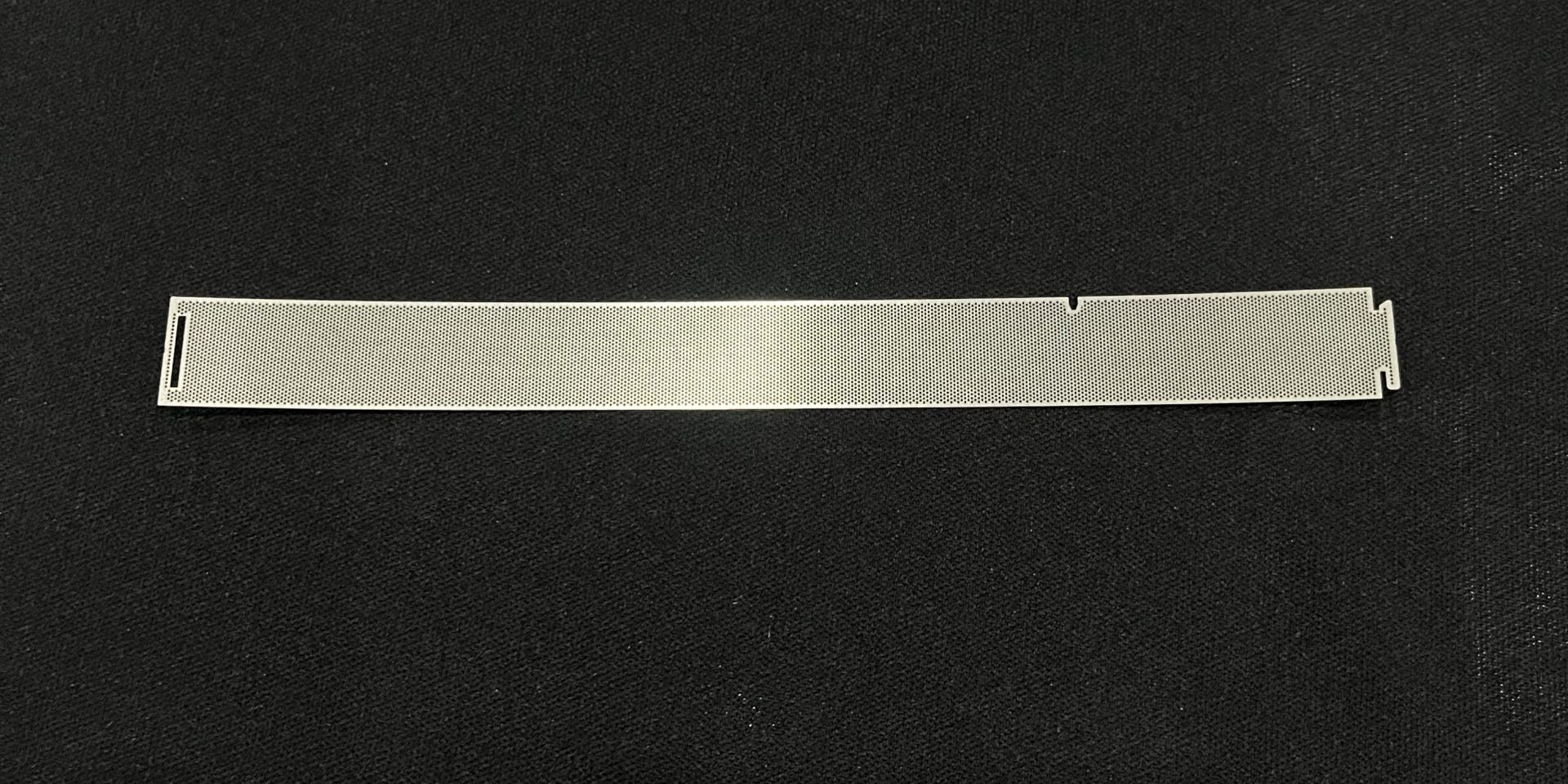
A quotation request that only says “etched mesh, 0.2 mm, 1,000 pieces” cannot be quoted properly, because the price-driving facts are missing. Send the drawing or CAD file with the pattern, and state: the material and grade (for stainless, the grade and, for 301, the temper — see our post on 301 vs 304 vs 316); the sheet thickness; which dimensions are critical and which are reference; the finish, including any plating specification; the quantity and the expected repeat pattern; and what the part does — a filter mesh, a shield, a sensor component — because the application decides which tolerances matter. A buyer who states the application gets a quotation checked against the real requirement; a buyer who sends geometry alone gets a quotation checked against nothing.
Check feasibility with three rules before you ask for a date
First, the thickness rule. If the drawing calls for a 0.1 mm hole in 0.3 mm stock, that hole will not etch cleanly — the etchant undercuts as it cuts down, and a hole much smaller than the sheet is thick closes up or goes ragged before it breaks through. Either the hole grows or the stock thins; both are drawing decisions, not production problems. Second, the tolerance rule. ±10% of thickness is the honest number for etched dimensions — it scales with the gauge, so a 0.5 mm part and a 0.2 mm part do not carry the same absolute tolerance, and a quotation that promises one flat number across all gauges should be questioned. Third, the half-etch rule. Any recess, channel, fold line or mark that is not a through-feature is a half-etch at 50–75% of thickness, controlled to ±0.05 mm — specify the depth, not just the presence, of the feature. Our post on photo etching tolerances works through all three rules with examples.
Choose the material for the job, not by habit
Stainless steel is the default for most etched parts — 304 for general use, 316/316L where chloride or marine exposure is real, 301 in a specified temper where a part must hold spring force. Copper suits conductivity and heat; brass (H62 is the standard grade) suits lead frames and contacts; nickel suits corrosion and spring applications; titanium earns its place where weight or aggressive chemistry matters. What we do not etch is aluminium, and we do not offer fuel-cell coatings or medical implant parts — if a drawing asks for those, it belongs with a different supplier, and we will say so at quotation rather than after samples.
Finishes and secondary operations: what is in-house and what is not
Passivation after etching is done in-house on every stainless part — it restores the chromium oxide layer that etching disturbs, and it is what keeps a corrosion advantage real rather than theoretical. Mesh spot welding is also in-house, so a mesh-and-frame assembly comes from one supplier. Plating of all types is available through qualified partners, as are secondary stamping, colour filling and bending or forming — those steps are outsourced and should be named on the drawing so the quotation covers them. One boundary matters for cold plates and flow plates: we supply the etched plate itself. Sealing, bonding and brazed assemblies are the customer’s own downstream steps, not ours.
Sampling, production and documents
Samples ship in 3–5 days and production in 7–10 days, on the same process — there is no tooling to build, so a design change is an artwork change and a revised sample runs the same 3–5 days. There is no minimum order quantity and the minimum order charge is US$100, so a 50-piece prototype order and a 50,000-piece production order are quoted on the same basis. Every order carries a material test certificate with per-run batch traceability; PPAP Level 3 documentation and IMDS data are available on request, and NDAs are accepted before drawings are shared.
When etching is the wrong process
Honesty here saves both sides a wasted sample run. If the part is thick, simple and high-volume with a frozen design, a stamping die may be cheaper — etching wins where the specification is the point: thin stock, fine features, complex outlines, small or moving volumes, and designs that still change. If the process needs continuous roll feeding, we cannot supply on reels — flat sheets only, cut to blanks. And if the finest feature is well below the stock thickness, the drawing needs revising before any supplier can etch it. A supplier who accepts all three cases without comment is not doing the buyer a favour.
FAQ
What do I need to send for a first quotation?
A drawing or CAD file with the pattern, material and grade, thickness, critical dimensions, finish and quantity — plus the application. That package is enough for a firm quotation and a feasibility check.
How tight a tolerance can I specify?
±10% of material thickness is the rule — ±0.02 mm on 0.2 mm stock, ±0.05 mm on 0.5 mm stock. Tighter absolute numbers on thin stock are the same rule applied, not a special process.
Can I order a single prototype?
Yes. There is no minimum order quantity; the minimum order charge is US$100 and samples ship in 3–5 days.
Do you sign NDAs before I share drawings?
Yes, on request, before any drawing is shared.
What if my part needs plating or forming as well?
Name it on the drawing. Plating is arranged through qualified partners and forming through outsourced secondary operations, quoted together with the etched part.
Send the drawing package
Xinketching etches flat precision parts in stainless steel, copper, brass, nickel and titanium from 0.05 to 2.5 mm, with samples in 3–5 days, production in 7–10 days, no minimum order quantity and a US$100 minimum order charge. Send the drawing package described above through our contact page or to sales@xinketching.com, and we will confirm feasibility against the three rules and quote it as drawn.

- What Does a 770 W/cm² GPU Hotspot Mean for the Etched Copper Flow Layer? - November 22, 2026
- Photo-Etched Precision Medical Metal Components: Micro-Needles, Lancets and Microfluidic Parts - November 21, 2026
- Custom Lead Frame Etching for IC Packaging: Photo-Etched vs Stamped Lead Frames - November 18, 2026