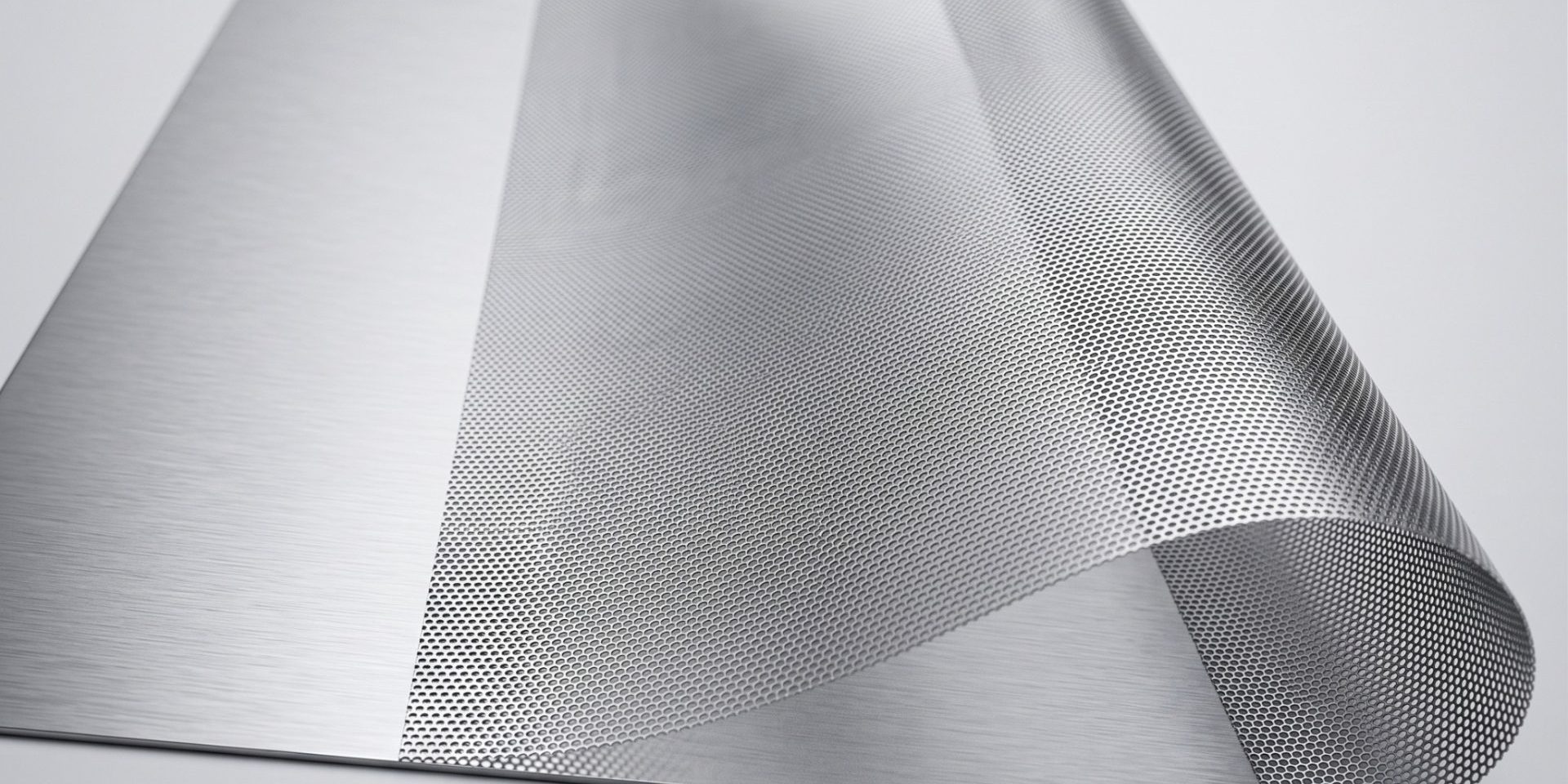
The manufacturability of a foldable-phone metal mesh or perforated support plate is controlled by the relationship between material thickness, opening size, pitch and remaining web width. A dense pattern may look simple on CAD, but the smallest web between holes often becomes the real process limit.

Why mesh-style geometry appears in foldable hardware
Foldable structures need to support a display while still allowing repeated bending in a defined region. Samsung’s Flex Titanium announcement describes micro-patterned holes in the folding section of a titanium plate. That public design example shows why engineers increasingly use controlled perforation patterns to tune local flexibility.
Source: Samsung: Flex Titanium display structure. This describes a product architecture, not a disclosed photo-etching route or a XINKETCHING supply relationship.
The four dimensions that should be reviewed together
| Dimension | DFM role |
|---|---|
| Material thickness (T) | Sets the basic scale for how aggressively small openings can be etched. |
| Opening width / diameter (D) | Too small relative to T increases risk of dimensional loss or incomplete opening. |
| Pitch (P) | Controls opening density and mechanical behavior. |
| Web / ligament (W) | Must remain wide enough after lateral etching to preserve strength and handling stability. |
A practical first-pass rule
Review minimum opening and remaining web together with thickness; neither is a universal process limit. For equal circular holes on a straight row, the nominal edge-to-edge web is W = P – D, where P is center-to-center pitch and D is hole diameter. Staggered arrays, slots and etched sidewall profiles need their own minimum-distance checks. This geometry calculation is not a tolerance guarantee.
Example: a 0.08 mm titanium sheet with 0.12 mm holes and adequate web is fundamentally more favorable than a 0.40 mm sheet with the same 0.12 mm holes.
Round holes vs slots vs lattice patterns
Different patterns affect both manufacturing and mechanical behavior:
- Round holes: simple to dimension and inspect; useful for uniform perforation.
- Long slots: can introduce directional flexibility and may be useful in a bend zone.
- Staggered hole arrays: increase open area while distributing remaining material.
- Lattice / complex repeating patterns: may tune stiffness more precisely but require careful minimum-web control.
Photo etching is attractive because pattern complexity does not require a separate punch for every geometry.
Do not over-tolerance every hole
In a large perforation field, the most important engineering requirement may be total open area, pitch stability, edge-to-pattern position or bending behavior rather than the diameter of every individual hole. Applying an unnecessarily tight bilateral tolerance to thousands of holes can increase cost without improving function.
Identify the characteristics that actually control assembly and mechanical behavior, then let the supplier propose a realistic process tolerance for the remaining dimensions.
Inspection strategy for dense patterns
- First article dimensional inspection on critical zones.
- Optical measurement of representative holes and web widths.
- Pitch / array-position checks across the sheet.
- Visual inspection for blocked openings, over-etch or damaged ligaments.
- Flatness and surface inspection when the plate is bonded into a display stack.
When to choose photo etching instead of punched mesh
Stamping can be excellent after a high-volume design is frozen, but dense fine patterns may require expensive tooling and create burr management issues. Photo etching is particularly useful for prototypes, evolving designs, multiple pattern variants and thin parts where a mechanical punch could distort the sheet.
For a broader mesh-process comparison, see laser processing mesh vs etching processing mesh.
Send the pattern, not only the open-area percentage
A useful quote needs the actual DXF/DWG pattern, material, thickness and tolerance. If the plate belongs to a foldable-phone or flexible-display project, also identify the folding region and the dimensions that control local flex behavior.
See the main foldable phone metal etching guide or email sales@xinketching.com for a drawing review.

- What Can a Pilot Lot Actually Prove About Etched-Part Repeatability? - October 9, 2026
- How Much Open Area Remains After an Acoustic Mesh Is Assembled? - October 8, 2026
- How Do You Compare Etched Prototypes Without Losing Track of the Design? - October 7, 2026