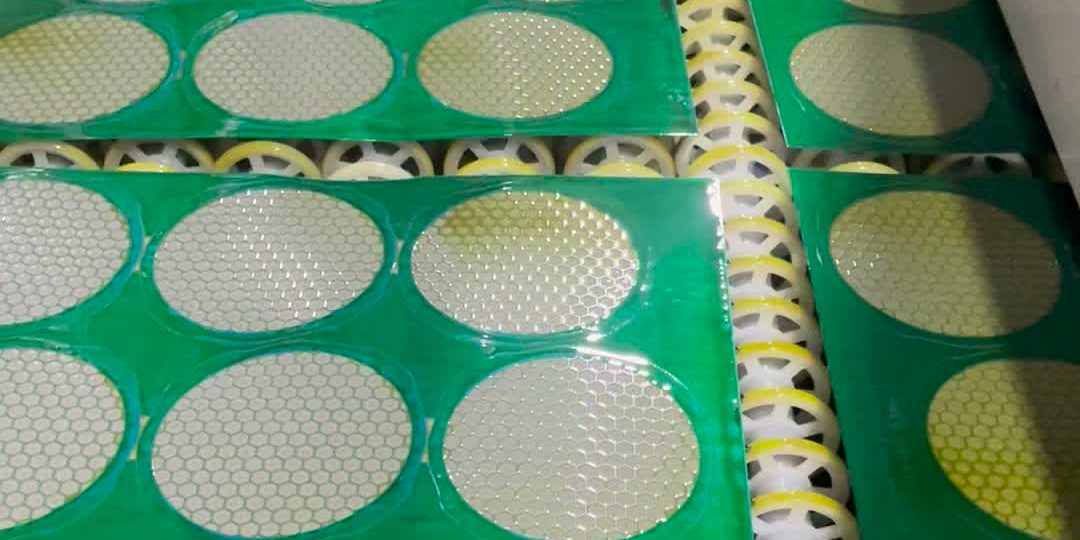
A printed circuit heat exchanger is a stack of thin metal plates with flow channels etched into them, bonded into a solid core. The idea is simple and unforgiving: put an enormous heat-transfer surface into a small volume, run two fluids past each other through etched channels, and let the metal do the work. The buyer’s question is narrower and harder: when does the plate want to be titanium, and what has to be on the drawing so the plate comes back right the first time?
Titanium earns the plate for two reasons that show up in the same places — seawater desalination and chemical plants. The first is corrosion. A desalination exchanger lives in hot, hyper-saline water; a chemical-plant exchanger lives in aggressive media. Titanium’s passive oxide film is what keeps it alive there, and it is also what makes the plate hard to etch — the same film that protects the finished exchanger blocks standard wet chemical etching. The second reason is weight. The experimental study on titanium PCHE channels puts it as a number: a titanium heat exchanger is about 43% lighter than a stainless-steel exchanger with the same heat-transfer area. On an offshore platform, a desalination skid or any installation where the exchanger is lifted, shipped or hung, that weight difference is a design decision, not a footnote.
The process case for etching the plate at all is settled in the same study. PCHE channels, usually made of stainless steel, are produced by chemical etching — but, the authors write, it is “extremely difficult to produce titanium channels for PCHEs by traditional methods such as wet chemical etching owing to the strong corrosion resistance of titanium”. Their answer was electrochemical etching: anodic dissolution in a NaCl-containing ethylene glycol electrolyte, with ultrasonic transducers added to the system. The numbers they report are the reason the method matters — ultrasonic exposure at 120 W and 50 kHz enhanced the corrosion rate by a factor of 4–5, and 45 °C gave the best comprehensive performance across etching rate, roughness and etching factor. Those are the researchers’ figures, for their experimental system, and this post does not adopt them as our process parameters. What they establish for a buyer is simpler: titanium PCHE channels are an etching problem with a known, studied answer — not a reason to give up on titanium.
Answer capsule: six things a buyer needs
- We etch titanium flow plates. Titanium is one of the five metals we photo-etch — stainless steel, titanium, copper, brass and nickel. We do not etch aluminium.
- We etch the plates, not the bonded core. A PCHE core is diffusion-bonded from a stack of etched plates. We supply the etched plates only — no diffusion bonding, no brazing, no sealed assemblies. Bonding and qualification are your step, and the plate drawing should be reviewed together with the bonding plan.
- Stainless is the default; titanium is the earned choice. Specify titanium when corrosion or weight decides the design — desalination, chemical service, offshore, nuclear-adjacent duty. If neither decides it, stainless is the better buy.
- Channel depth is a half-etch. Flow channels are etched 50–75% of the plate thickness with ±0.05 mm depth control. On 0.5 mm stock that is a channel roughly 0.25–0.38 mm deep; on 1.0 mm stock, roughly 0.5–0.75 mm. Through-features — ports, distribution holes — follow the thickness rule instead: roughly 0.8–1.2× the material thickness as a minimum.
- Tolerance is ±10% of thickness. On 0.5 mm stock that is ±0.05 mm; on 1.0 mm stock, ±0.10 mm. Thickness is the number the channel depth and the plate flatness are built around.
- Flat plates only, to 600 × 1,450 mm. We etch flat sheets; full size only at 0.5 mm and above, thinner gauges run smaller. A plate that needs a bend or a formed feature is a formed part: bending/forming is outsourced and must be confirmed at quotation.
Specifications
- Materials: stainless steel (304, 316L) is the default; titanium, copper, brass and nickel also etched (we do not etch aluminium)
- Titanium grades etched: commercially pure Grades 1 and 2 and alloy Grade 5 (Ti-6Al-4V); Grade 2 is the usual choice for corrosion-exposed plates, Grade 5 the higher-strength choice where the plate carries load
- Thickness range: 0.05–2.5 mm — gauges 0.05, 0.08, 0.1, 0.12, 0.15, 0.2, 0.25, 0.3, 0.4 and 0.5 mm stocked; above 0.5 mm up to 2.5 mm sourced per order
- Maximum flat sheet: 600 × 1,450 mm — full size only at 0.5 mm and above; thinner gauges run smaller
- Tolerance: ±10% of material thickness
- Half-etch (flow channels, recesses): 50–75% of thickness, depth control ±0.05 mm
- Through-features (ports, distribution holes): ≈ 0.8–1.2× material thickness minimum (0.20 mm hole in 0.3 mm stock declined)
- Form: flat sheets only — no coil, no reel; bonding/brazing not offered
- Finish: passivation available in-house; plating and surface treatment outsourced
- Lead time: samples 3–5 days when material is in stock (7–10 days for special material not stocked); production 7–10 days
- Commercial: no MOQ; US$100 minimum order; FOB; material test certificate + per-run batch numbers on every order; PPAP Level 3 documentation available
Why titanium earns the plate — and when it does not
Corrosion is the first reason, and desalination is the clearest case. FlotteTech, which builds PCHEs for Middle East desalination and membrane concentration, specifies titanium where the water is hyper-saline and the ambient temperature exceeds 50 °C, and puts it plainly: “for highly corrosive marine environments or acid processing, Titanium plates provide long-term resistance to pitting and corrosion”. The ScienceDirect study makes the same point from the research side: seawater desalination driven by nuclear power “requires a corrosion-resistant heat exchanger”, and titanium is the promising material for it. A chemical plant is the same argument with different chemistry — an exchanger that must survive aggressive media for years is not the place to save money on the plate metal. Our titanium guide covers grade choice in general; Grade 2 is the corrosion-first choice for these plates.
Weight is the second reason, and it is arithmetic. Titanium at ≈ 4.5 g/cm³ against steel at ≈ 7.9 g/cm³ means the same plate at the same thickness weighs about 57% of the steel plate — and the study’s system-level figure, about 43% lighter for the titanium exchanger at the same heat-transfer area, is the number to carry into a weight budget. For an offshore platform or a skid that is craned into place, that saving is real money. For a ground-level plant exchanger that never moves, it is not a reason to pay the titanium premium. State the deciding reason in one line on the enquiry, and the quotation will show whether titanium earns it.
When neither reason decides the design, stainless wins: it costs less, every PCHE shop in the world knows how to bond it, and the channel geometry that works in stainless works the same way in titanium. The honest specification names the deciding reason — corrosion, weight, or both — instead of specifying titanium by habit. The same discipline applies to the rest of the exchanger: our PCHE explainer sets out what the etched plate is and is not in the finished system, and our heat-exchanger manufacture post covers why etching is chosen for these plates at all.
The etching problem, stated plainly
Titanium is hard to etch for the same reason it survives in service: the moment it meets air it forms a protective oxidised coating, and standard etch chemistries cannot get through it. That is not a marketing line — it is the opening problem of the ScienceDirect study, which notes that etching methods to fabricate fluid channels on titanium plates for PCHEs “have not been reported in the open literature” and that published methods “do not have enough etching rate and production scale to produce a certain amount of fluid channels on titanium plates efficiently”. The study’s answer, electrochemical etching with ultrasonic assistance, is a research result — not our production process — and this post does not claim we run their parameters. What a buyer should take from it is the shape of the problem: titanium channels are a specialist etch, and a supplier who treats them like stainless channels has not understood the metal.
For the buyer, the practical consequence is a drawing question, not a chemistry question. The channel is a half-etch: 50–75% of the plate thickness, depth-controlled to ±0.05 mm. On 0.5 mm stock the channel runs roughly 0.25–0.38 mm deep; on 1.0 mm stock, roughly 0.5–0.75 mm. That depth is the number the flow and pressure-drop calculations are built around, so it belongs on the drawing next to the thickness — not buried in a note. Through-features are a different rule: a port or distribution hole floors at roughly the material thickness (0.8–1.2×). A 0.20 mm hole in 0.3 mm stock is a case we declined; the fixes are thinner stock or a larger feature. Our tolerances post works through the ±10% arithmetic; the same numbers govern a flow plate, a bipolar plate and a shim. The same etched-flat logic behind our bipolar-plate post for PEM electrolyzers applies here — a different product, but the same channel-depth, pitch and flatness discipline.
Desalination and chemical service: what the drawing must carry
A desalination or chemical-plant plate carries five things on its drawing, and the quotation is only as good as the weakest of them.
- Material and grade. State titanium, and the grade — Grade 2 or Grade 5 — with the reason in one line (corrosion exposure, or structural load). If the service does not need titanium, say so: we etch stainless steel as well, and the honest answer is sometimes the cheaper metal.
- Thickness. This is the functional dimension. Put the nominal thickness and design around ±10% of it. Do not specify below our stocked 0.05 mm, and do not specify a tolerance tighter than ±10% without asking first — a channel specified at ±0.01 mm on 0.5 mm stock is asking for a tolerance the process does not hold.
- Channel width, depth and pitch. State the channel pattern with its width, depth and pitch — depth as a half-etch (50–75% of thickness, ±0.05 mm), width against the thickness rule. Chemical Processing’s rule of thumb for PCHE channels is typically 2-mm semicircular cross-sections — a useful sanity check for scale, not a specification. The pattern is the product: it is photographed into the metal from one artwork, so plate one and plate ten thousand carry the identical pattern.
- Ports and registration. Ports, distribution holes and any mounting features are etched in the same pass as the channels, from the same artwork — so the pattern sits relative to the ports by design. Put the port tolerance on the drawing next to the channel pitch, and state the registration requirement for the stack, because the plates must line up when they are bonded.
- Finish. State the finish — passivation is available in-house; plating and other surface treatment are outsourced. And state the fluid: a PCHE’s channels are small, and Chemical Processing’s warning is blunt — the fluids “must be extremely clean and free of any debris, solids, etc.” If the stream carries solids, the exchanger needs filtration upstream. Say so on the enquiry, and the quotation will show the finish and any pre-filtration as their own lines.
One more drawing item matters more here than in electronics cooling: the plate is not the exchanger. Our cold-plate post is about liquid-cooling plates for electronics — a different product, a different duty. A desalination or chemical PCHE plate goes into a bonded core that must hold pressure, and the bonding method, the header design and the inspection plan are the exchanger maker’s responsibility. Provide the individual plate drawing and the stack/bonding requirements, not only the finished exchanger specification — that is the same advice our PCHE explainer gives, and it is the advice that keeps a quotation honest.
What etching does — and what it does not do
Photo-chemical etching removes metal chemically, not mechanically, so a thin titanium flow plate comes out flat, stress-free and burr-free, with the same artwork producing the first plate and the ten-thousandth. That repeatability is the case for etching flow plates: a channel pattern that must repeat across a whole stack cannot absorb a supplier whose dimensions wander. Stamping gets there with a precision die that wears; machining gets there one plate at a time, slowly. Neither failure mode exists in etching, because there is no die and no cutter.
The boundaries are equally plain. Etching makes flat plates — sheets up to 600 × 1,450 mm at 0.5 mm and above — not coil or reel-fed strip, not a bonded core, not a finished exchanger. We do not etch aluminium, we do not apply fuel-cell coatings, and we do not build brazed or diffusion-bonded assemblies. FlotteTech’s pressure and temperature figures (up to 100 MPa, cryogenic to 900 °C) and Chemical Processing’s 98% thermal-efficiency figure are those companies’ claims for their exchangers, not ours; our quality documentation is PPAP Level 3, material test certificates and per-run batch numbers. A buyer who needs certified quality documentation should ask for our current documentation at quotation and judge it on its own terms — and should confirm with their own thermal team whether an etched plate meets their exchanger requirements, because that determination belongs to the exchanger designer, not to the plate supplier.
FAQ
Can you etch titanium flow plates for a PCHE?
Yes — flat etched titanium plates in 0.05–2.5 mm, Grades 1, 2 and 5. We supply the etched plates only; diffusion bonding or brazing the core is not offered.
How deep can the flow channels be?
Channels are half-etched 50–75% of the plate thickness, depth control ±0.05 mm. On 0.5 mm stock that is roughly 0.25–0.38 mm deep; on 1.0 mm stock, roughly 0.5–0.75 mm.
How fine can the channels and ports be?
Through-features floor at roughly the material thickness (0.8–1.2×). A 0.20 mm hole in 0.3 mm stock is a declined enquiry; finer features need thinner stock, not a harder etch.
When should I specify titanium instead of stainless for a flow plate?
When corrosion or weight decides the design — desalination, chemical service, offshore or nuclear-adjacent duty. If neither decides it, stainless is the better buy.
What do you need on the drawing?
Five items: material and grade (Grade 2 or Grade 5, with the reason), nominal thickness (design around ±10%), channel width, depth and pitch, port tolerance and stack registration, and finish — with the fluid and its cleanliness stated, since PCHE channels need clean fluids.
Do you bond the PCHE core?
No. The core is diffusion-bonded or brazed from a stack of etched plates, and bonding is the customer’s step. Provide the plate drawing and the stack/bonding requirements, and the quotation will cover the etched plates.

- What Does a 770 W/cm² GPU Hotspot Mean for the Etched Copper Flow Layer? - November 22, 2026
- Photo-Etched Precision Medical Metal Components: Micro-Needles, Lancets and Microfluidic Parts - November 21, 2026
- Custom Lead Frame Etching for IC Packaging: Photo-Etched vs Stamped Lead Frames - November 18, 2026