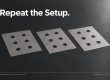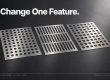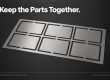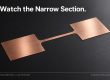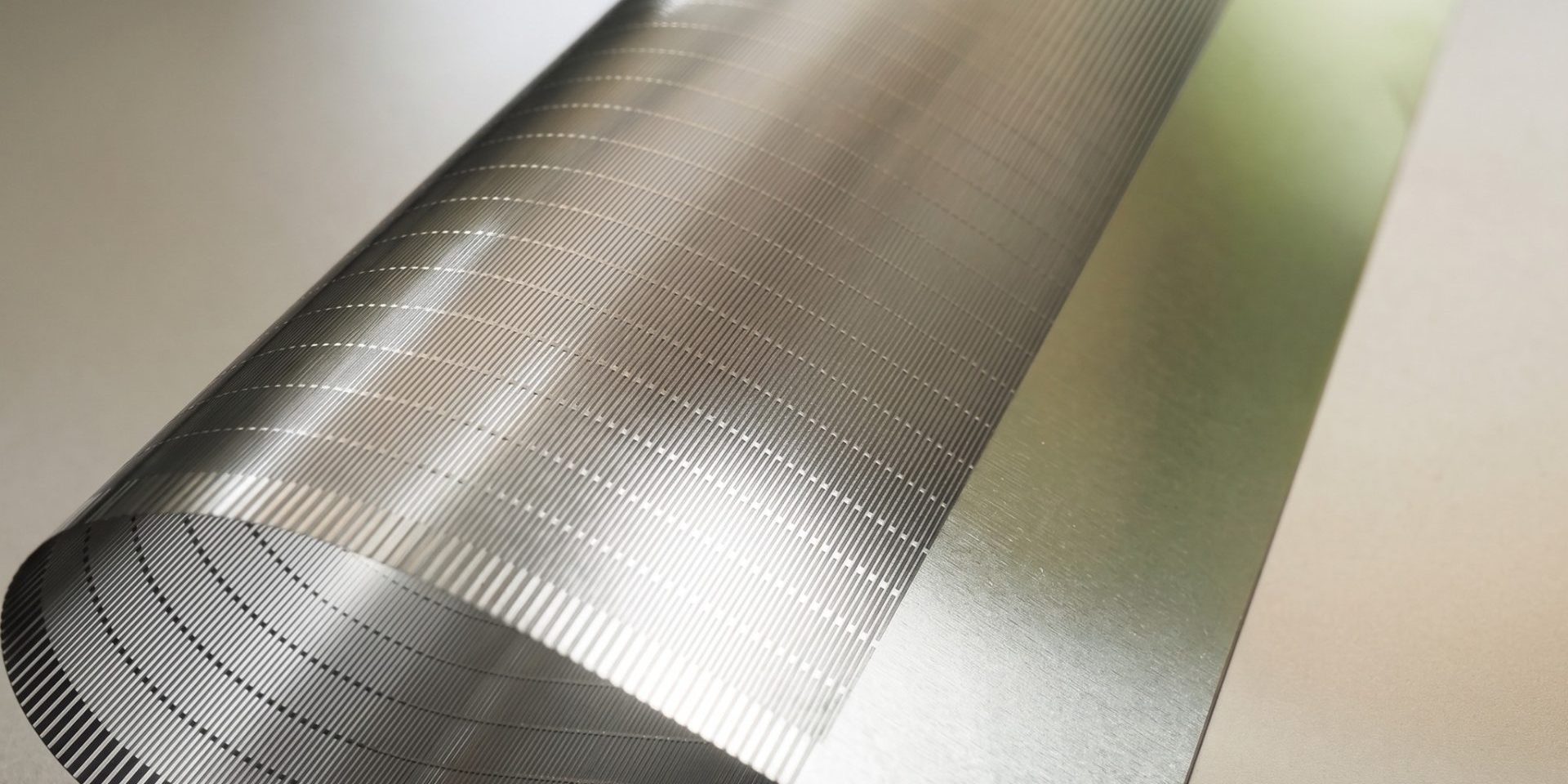
Direct answer: for a thin, flat titanium support plate containing many repeated holes or slots, photochemical etching is often worth evaluating before laser cutting. Laser remains a strong option for simple profiles, low feature counts or designs where its achievable tolerance and edge condition are acceptable. The drawing should decide the process.

The foldable-phone use case
Modern foldable displays increasingly use thin support structures that must balance stiffness with local flexibility. Samsung’s 2026 Flex Titanium announcement describes a titanium plate beneath the display with micro-patterned holes in the folding region. The company does not disclose the manufacturing process, but the geometry is a useful engineering example: a thin plate plus a large number of precision openings.
Source: Samsung Global Newsroom — Flex Titanium
Photo etching vs laser cutting
| Factor | Photo etching | Laser cutting |
|---|---|---|
| Dense repeated holes | Pattern is processed across the sheet; complexity has relatively low incremental cycle cost. | Beam must trace individual features, so feature count affects cut time. |
| Heat input | No laser heat-affected zone. | Localized thermal input is inherent to the process. |
| Mechanical burr | No mechanical cutting burr. | Edge quality depends on material, thickness, laser type and parameters. |
| Tooling | Digital phototool; inexpensive to revise. | No hard tooling; program revisions are fast. |
| Simple large profiles | Can work, but may not be the lowest-cost option. | Often very competitive. |
| Very small features relative to thickness | Limited by isotropic undercut and chemistry. | Limited by beam/kerf, heat and material response. |
Why feature count matters
A laser processes geometry sequentially. A photo-etched sheet is patterned photographically and then chemically processed across the whole exposed area. That difference becomes important when a support plate contains hundreds or thousands of openings. In this type of design, photo etching can turn “complexity” into a less expensive variable than it would be in a point-by-point cutting process.
Why edge condition matters
Foldable-display support components may sit close to adhesives, films, flex circuits and extremely thin display layers. The required edge condition therefore matters as much as nominal XY tolerance. Photo etching produces no stamped burr and no laser recast zone. It does, however, produce an etched edge profile and undercut that must be accounted for in DFM.
Where laser may win
- Very low quantity simple parts where no phototool setup is justified.
- Large outside profiles with only a few openings.
- Features for which laser tolerance and edge requirements are already proven.
- Parts that require immediate one-off cutting from available sheet.
Where photo etching may win
- Thin titanium or stainless-steel plate with dense micro-hole arrays.
- Prototype designs expected to change repeatedly.
- Parts sensitive to heat input or mechanical burrs.
- Multiple different part geometries nested on the same production sheet.
- Designs combining through features with half-etched marks or recesses.
Do not compare processes from the part name alone
“Titanium support plate” is not enough information. XINKETCHING needs material grade, thickness, minimum hole/slot, minimum web, critical tolerance, quantity and surface requirements before recommending etching rather than laser.
Start with the foldable phone metal etching manufacturer guide, then send the drawing to sales@xinketching.com for DFM review.

- Etched Filters for Hydraulic and Analytical-Instrument Systems - October 25, 2026
- Etching Titanium: When the Weight or the Chemistry Earns It - October 24, 2026
- Etching Copper and Brass: What Changes vs Stainless Steel - October 23, 2026