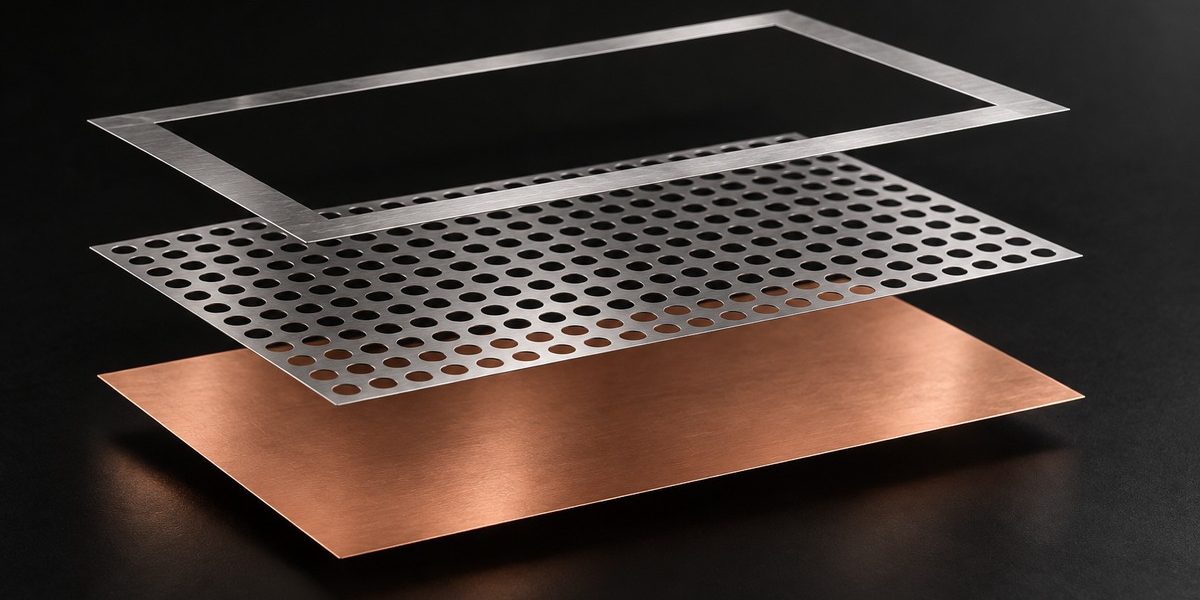
A vapor chamber can look like one flat copper part from the outside. Inside, several features do different jobs: containing the working fluid, supporting the enclosure and returning condensed liquid to the heated region. A thin metal layer that performs one of those jobs is a possible etching project. It is not, by itself, a finished cooling system.
Photo etching is worth evaluating for thin flat spacers, patterned support layers and selected perforated components. The decision turns on the required geometry, alloy and joining route. A porous wick, a sealed enclosure and a patterned foil are different manufacturing problems, even when they occupy the same small assembly.

Which feature is the foil supposed to control?
Start with its function in the stack. A spacer sets a gap. A perforated support layer leaves routes through the metal while supporting adjacent surfaces. A sealing land provides uninterrupted material at the joint. Those functions can conflict: increasing the open area also removes support, and carrying a hole pattern too close to the perimeter reduces the solid land available for joining.
This is where a drawing becomes useful to an etching supplier. Show the continuous perimeter, the pattern and the locating features together. A drawing of isolated openings hides the relationship between the pattern and the part that must hold it.
Thin sheet gives the process an advantage—and a limit
Photochemical machining exposes many features during the same etching operation. Dense repeated geometry therefore does not require a cutting tool to visit every opening separately. However, lateral material removal affects the edge profile. Changing sheet thickness while retaining the same tiny openings can change manufacturability substantially.
The pattern also needs to survive the next operation. A delicate foil may be easy to make and difficult to position. Registration holes or a temporary carrier can help, provided they fit the assembly sequence. Joining pressure, surface preparation and the behavior of the finished stack belong in the thermal assembly design, rather than being inferred from an attractive foil sample.
Why this question is appearing in electronics projects
Apple’s September 9, 2026 product announcement describes a redesigned vapor chamber. That makes compact thermal packaging a current application topic; it does not establish the manufacturing route of the internal layers. For another design, the useful question is which individual sheet-metal features suit etching.
For an initial XINKETCHING drawing discussion, identify the layer’s job and show its neighboring surfaces. That makes it possible to discuss the metal component without confusing its dimensional requirements with the thermal performance of the complete device.
Related engineering reading: metal etching process and DFM guide.
References: Apple, iPhone 18 Pro and iPhone 18 Pro Max announcement (2026-09-09); Precision Micro, Chemical Etching Technical Guidelines (accessed 2026-09-16).

- What Can a Pilot Lot Actually Prove About Etched-Part Repeatability? - October 9, 2026
- How Much Open Area Remains After an Acoustic Mesh Is Assembled? - October 8, 2026
- How Do You Compare Etched Prototypes Without Losing Track of the Design? - October 7, 2026