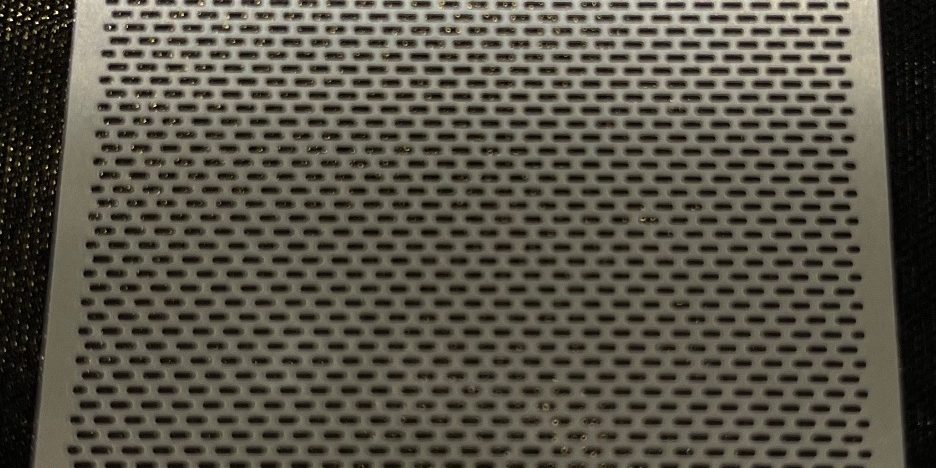
A sorting mesh is judged by one thing: whether every aperture is the size the drawing says it is. In diamond sorting, powder classification and precision filtration, a hole that drifts by a few microns sorts the wrong fraction — and a batch sorted wrong is a batch reworked or rejected. Photo etching earns its place here for a simple reason: every aperture in the sheet comes from the same artwork in the same pass, so the apertures hold together across the whole part instead of drifting hole by hole. Xinketching is a precision photochemical etching manufacturer in Dongguan, China, producing flat etched metal parts since 2005. This guide sets out what makes an etched sorting mesh accurate, where the limits sit, and how to specify one so the quotation covers it.
Answer capsule: six things a buyer needs
- Accuracy comes from the artwork, not the tool. All apertures are etched in one pass from one artwork, so aperture size and spacing hold together across the sheet — the property a sorting mesh is bought for.
- The hole floor is the thickness rule. A through-aperture floors at roughly the material thickness (0.8–1.2× as a rule of thumb); a finer aperture needs thinner stock, not a harder etch.
- Tolerance is ±10% of thickness. On 0.1 mm stock that is ±0.01 mm; on 0.2 mm stock, ±0.02 mm — the number to design the sorting cut around.
- Etching beats weaving and stamping where accuracy matters. No woven wire to shift, no punch wear to drift the aperture, no burr to catch the sorted fraction.
- Sheets are flat and burr-free. Etching adds no mechanical stress and no heat, so a thin mesh stays flat and its edges come out burr-free.
- The commercial baseline is unchanged. Samples in 3–5 days, production in 7–10 days, no minimum order quantity, a US$100 minimum order charge, FOB — with a material test certificate and per-run batch traceability on every order.
Specifications
- Materials: stainless steel, copper, brass, nickel, titanium (we do not etch aluminium)
- Thickness range: 0.05–2.5 mm — gauges 0.05, 0.08, 0.1, 0.12, 0.15, 0.2, 0.25, 0.3, 0.4 and 0.5 mm are stocked; above 0.5 mm up to 2.5 mm is sourced per order
- Dimensional tolerance: ±10% of material thickness
- Minimum through-features: ≈ material thickness (design rule ≈ 0.8–1.2× thickness)
- Half-etched features: ≈50–75% of thickness, depth control ±0.05 mm
- Format: flat sheets only, no coil/reel-to-reel; maximum single sheet 600 × 1,450 mm for material 0.5 mm and above; parts supplied flat, cut to outline or nested in the sheet
- Finishing: passivation in-house on stainless; plating of all types via qualified partners; mesh spot welding in-house
- Lead times and order terms: samples 3–5 days, production 7–10 days; no minimum order quantity, minimum order charge US$100; FOB
- Quality documents: material test certificate with per-run material batch traceability; PPAP Level 3 supported; IMDS data available; NDAs on request
Why aperture accuracy is the whole job
Sorting is a measurement disguised as a part. A sieve that passes a 0.20 mm particle through a 0.19 mm hole has not sorted anything — it has mis-measured. Woven mesh drifts because wires move; stamped mesh drifts because punches wear and every hole is a separate mechanical event. An etched mesh has neither failure mode: the artwork defines every aperture at once, the etchant works the whole sheet at once, and the result is a field of apertures that agree with each other. That agreement is what a sorting buyer is actually paying for, and it is also what makes the first sample meaningful — a sample that measures right predicts the production run, because the process that made the sample is the process that makes the run. Our post on photo etching tolerances works through the tolerance numbers; the sorting cut should be designed around them, not around a nominal aperture the process cannot hold.
The thickness rule, applied to a mesh
Every mesh enquiry should start with two numbers: the aperture the sorting needs, and the thickness the part needs. The etching rule ties them together — a through-aperture cannot reliably go much below the material thickness, roughly 0.8–1.2× as a rule of thumb. A 0.20 mm aperture in 0.3 mm stock is a declined enquiry, not a difficult one; the honest fixes are thinner stock or a larger aperture, and both are cheaper to settle before samples than after them. Thickness is not only a limit, it is a choice: thinner stock gives finer apertures and a lighter mesh, thicker stock gives stiffness and handling strength. Stainless steel is the default for a durable sorting mesh; copper and brass suit applications where conductivity or a specific surface matters; nickel suits corrosion and spring applications. The mesh itself is supplied flat, cut to outline or nested in the sheet — and only as a flat part, never on a reel.
What to put on the drawing
Four items, on the drawing itself. First, the aperture: nominal size and its tolerance, not a nominal size alone — a sorting mesh specified without an aperture tolerance cannot be quoted properly, because the tolerance is the sorting cut. Second, the pitch: aperture spacing and its tolerance, since spacing decides the open area and the flow or throughput of the mesh. Third, the material and thickness, with the grade where it matters — our post on 301 vs 304 vs 316 sets out where each grade earns its premium. Fourth, the outline and any mounting or frame features, including whether mesh spot welding to a frame is part of the order — welding is done in-house and should be quoted with the mesh, not discovered after it. A drawing that carries those four items gets a quotation that covers the mesh; a drawing that carries only an aperture size gets a round of questions first. Our buyer’s guide lists the full drawing package.
Where etched mesh does not belong
Two boundaries, stated plainly. Etching makes flat mesh, not woven wire cloth and not deep-drawn baskets or three-dimensional filter housings — a formed filter body is a different process. And a mesh that needs a coating for its function — a fuel-cell coating, for example — belongs with a different process; we do not apply fuel-cell coatings. Both are worth stating at quotation rather than discovering after samples. The same rule covers the rest of the factory: no aluminium etching, no brazed assemblies, no sealed finished chambers — the etched mesh itself is what we supply, and downstream assembly is the customer’s own step.
FAQ
- Can you etch a 0.10 mm aperture in 0.30 mm stainless? No — a through-aperture floors at roughly the material thickness, so a 0.10 mm hole needs stock around 0.10 mm or thinner, or a larger aperture. Send the aperture and the thickness and we will confirm the feasible combination before samples.
- How consistent are apertures across a sheet? All apertures come from one artwork in one pass, so they hold together across the sheet within the ±10%-of-thickness tolerance. A sample measures the production run because the process is the same.
- What materials can a sorting mesh be made in? Stainless steel, copper, brass, nickel and titanium, 0.05–2.5 mm. We do not etch aluminium — if a drawing calls for it, we say so at DFM, not after samples.
- Is there a minimum order for a mesh? No minimum order quantity; the minimum order charge is US$100. Samples ship in 3–5 days and production runs in 7–10 days.

- What Does a 770 W/cm² GPU Hotspot Mean for the Etched Copper Flow Layer? - November 22, 2026
- Photo-Etched Precision Medical Metal Components: Micro-Needles, Lancets and Microfluidic Parts - November 21, 2026
- Custom Lead Frame Etching for IC Packaging: Photo-Etched vs Stamped Lead Frames - November 18, 2026