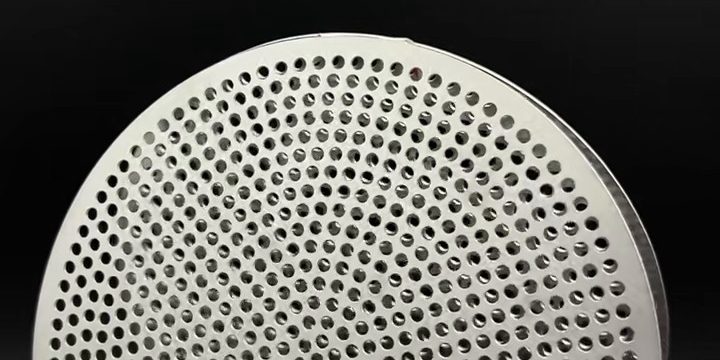
Samsung’s Galaxy Z Fold 8, launched in July 2026, hides its most interesting metal part where nobody can see it: underneath the folding display. The support plate beneath the OLED panel — the part that decides whether the screen folds smoothly hundreds of thousands of times and whether the crease deepens or stays put — is no longer a plastic film. Samsung calls the new structure Flex Titanium, and its working part is an etched titanium plate: a Grade 4 titanium plate carrying a fine grid of openings made by wet etching and laser processing. The larger etched openings sit in the fold zone, where the plate has to move; microscopic laser perforations support the display everywhere else. That combination is the story of this post — what the etched lattice does, and how a plate like it is specified. One thing to state up front: titanium is one of the metals we etch. Xinketching is a precision photochemical etching manufacturer in Dongguan, China, producing flat etched metal parts since 2005, and a flat titanium plate with etched openings is squarely in our process. We do not supply Samsung, and nothing here claims we do — but the part itself, and the questions a buyer should ask about it, are exactly our subject.
Answer capsule: six things a buyer needs
- The lattice is the fold. The etched plate’s job is twofold: large openings in the fold zone let the plate flex, and fine perforations elsewhere keep the display supported — one plate, two zones, two different opening patterns.
- We etch titanium. Titanium is one of the five metals we etch — stainless steel, titanium, copper, brass and nickel — in flat sheets from 0.05 to 2.5 mm. A titanium plate with etched openings is a part we make, not a material we turn away.
- The plate is not the foil. Samsung’s Flex Titanium pairs the etched plate with a separate cold-rolled titanium alloy foil about 23 micrometres thick — roughly a third of a human hair. The foil is rolled, not etched, and at 23 micrometres it is thinner than our thinnest stock (0.05 mm); the etched part is the plate.
- Tolerance is ±10% of thickness. On 0.2 mm stock that is ±0.02 mm; on 0.1 mm stock, ±0.01 mm — the number to design the lattice around.
- The hole floor is the thickness rule. A through-opening floors at roughly the material thickness (0.8–1.2× as a rule of thumb); a finer lattice needs thinner stock, not a harder etch.
- The commercial baseline is unchanged. Samples in 3–5 days, production in 7–10 days, no minimum order quantity, a US$100 minimum order charge, FOB — with a material test certificate and per-run batch traceability on every order.
Specifications
- Materials: stainless steel, titanium, copper, brass, nickel (we do not etch aluminium)
- Thickness range: 0.05–2.5 mm — gauges 0.05, 0.08, 0.1, 0.12, 0.15, 0.2, 0.25, 0.3, 0.4 and 0.5 mm are stocked; above 0.5 mm up to 2.5 mm is sourced per order
- Dimensional tolerance: ±10% of material thickness
- Minimum through-features: ≈ material thickness (design rule ≈ 0.8–1.2× thickness)
- Half-etched features: ≈50–75% of thickness, depth control ±0.05 mm
- Format: flat sheets only, no coil/reel-to-reel; maximum single sheet 600 × 1,450 mm for material 0.5 mm and above; parts supplied flat, cut to outline or nested in the sheet
- Finishing: passivation in-house on stainless; plating of all types via qualified partners
- Lead times and order terms: samples 3–5 days, production 7–10 days; no minimum order quantity, minimum order charge US$100; FOB
- Quality documents: material test certificate with per-run material batch traceability; PPAP Level 3 supported; IMDS data available; NDAs on request
What the etched lattice does
Every foldable before the Fold 8 used a carbon-fibre-reinforced polymer film beneath the OLED panel — effectively a high-grade plastic that provided structural support and decided how the display behaved when folded. That film was the part Samsung replaced to attack the crease: a polymer film is far less stiff than metal, and the crease deepened over time as the film aged under repeated folding. Samsung’s answer, developed over seven years of foldable work according to EVP BD Yang, was to replace the polymer with titanium — strong, dimensionally stable, fatigue-resistant — and then to solve titanium’s own problem, which is that it is inherently rigid. A rigid plate cannot fold hundreds of thousands of times. An etched lattice can: the openings are the flexibility.
The lattice works because it is not one pattern but two, in the same plate. In the fold zone, larger etched openings let the metal move — the plate bends where the openings are, and the openings are placed where the bending happens. Everywhere else, microscopic laser perforations keep the display supported, so the panel does not sag into unsupported gaps over time. Samsung’s disclosure at its July 2026 launch, reported by Notebookcheck, describes exactly this split: wet etching for the larger structural holes, laser for the finer surface patterns. Android Headlines, reporting the same disclosure, adds that the redesigned micro-aperture pattern uses smaller, denser perforations than before, so the support under the OLED panel is continuous rather than patchy. And Tech Times, reporting Samsung’s September Tokyo roundtable, adds a third effect of the lattice: it eliminates the air gaps that used to sit between the display module and its adhesive layer — gaps that made the crease look worse by letting the layers separate locally under bending stress.
The result, in Samsung’s figures: the display module is about 10% thinner, the visible crease is reduced, and the freed internal space let Samsung fit a 5,000 mAh battery into the Galaxy Z Fold 8 Ultra’s 4.1 mm body. The standard Fold 8 weighs about 201 grams and folds to 4.5 mm. The crease is reduced, not eliminated, but the titanium film’s higher stiffness helps the fold area recover its shape after each opening. All of those figures are Samsung’s, as reported by Notebookcheck and Tech Times; the point for a buyer of etched plates is narrower and more useful: the lattice is doing three jobs at once — flexing, supporting, and closing air gaps — and each job is a different opening pattern on the same drawing.
The plate is not the foil
Flex Titanium has two titanium components, and they are made differently — confusing them is the most common mistake in reading this news. The first is the plate: a Grade 4 titanium plate with the etched lattice described above. The second is a titanium alloy foil, about 23 micrometres thick — roughly a third of a human hair — made from a beta-class alloy containing vanadium, aluminium and chromium, chosen because beta-phase titanium alloys cold-form better than aerospace-standard grades. The foil is produced by precision cold rolling, not by etching, and it provides about 20 times the mechanical stiffness of the polymer film it replaces. The foil is the reason the display feels flat and recovers after folding; the plate is the reason the foil has something structured to sit on.
For a buyer, the distinction matters because the two components have different suppliers and different limits. A 23-micrometre foil is thinner than our thinnest stocked gauge — our range starts at 0.05 mm, or 50 micrometres — so the foil itself is not a part we etch, and we say so plainly. The plate is. A flat titanium plate, 0.05 to 2.5 mm, with etched openings, is exactly the kind of part our process makes: the openings come from one artwork in one pass, so the lattice holds together across the whole plate instead of drifting opening by opening. Our post on etching titanium sets out where titanium earns its premium over stainless — weight, chemistry, or both — and our comparison of titanium vs stainless steel for foldable display support plates works through the material choice for this exact application.
How such a plate is specified
A plate like Samsung’s is specified the way any etched lattice plate is specified — four items, on the drawing itself. First, the openings: nominal size and its tolerance, separately for the fold zone and the support zone, not a single nominal size for the whole plate — the two zones do different jobs, and a plate specified with one opening size cannot be quoted properly. Our post on photo etching tolerances works through the tolerance numbers, and our post on foldable phone metal mesh hole pitch covers pitch tolerance for this exact product family. Second, the pitch and the pattern zones: opening spacing, the boundary between the fold zone and the support zone, and their tolerances, since spacing decides both flexibility and support. Third, the material and thickness, with the grade where it matters — Grade 4 in Samsung’s case, and the grade is part of the specification, not an afterthought, because the grade decides both etch behaviour and fatigue life. Fourth, the outline and mounting features — the plate edge, the cutouts, and whether the plate needs passivation or a finish, which should be quoted with the plate, not discovered after it. A drawing that carries those four items gets a quotation that covers the plate; a drawing that carries only an opening size gets a round of questions first.
The etching rule ties the numbers together: a through-opening cannot reliably go much below the material thickness, roughly 0.8–1.2× as a rule of thumb. A 0.20 mm opening in 0.3 mm stock is a declined enquiry, not a difficult one; the honest fixes are thinner stock or a larger opening, and both are cheaper to settle before samples than after them. The same hole-agreement logic that decides spray uniformity or filtration is worked through for sorting applications in our sorting mesh post — different product, same rule: all openings from one artwork in one pass, so they agree with each other.
Where etched titanium plates do not belong
Two boundaries, stated plainly. Etching makes the flat plate, not the assembled display — the OLED panel, the adhesive stack, the hinge and the housing are other processes, and downstream assembly is the customer’s own step. And a plate that needs a coating for its function belongs with a different process; we do not apply fuel-cell coatings. Both are worth stating at quotation rather than discovering after samples. The same rule covers the rest of the factory: no aluminium etching, no brazed assemblies, no sealed finished chambers — the etched plate itself is what we supply. We do not supply Samsung, and no part of this post suggests otherwise; it is a report on published news, and a guide to specifying the kind of part the news describes.
FAQ
Can you etch a titanium plate with a lattice pattern like the Fold 8’s?
Yes — titanium is one of the metals we etch, in flat sheets from 0.05 to 2.5 mm. Send the opening sizes for the fold zone and the support zone, the pitch, the grade and the thickness, and we will confirm the feasible combination before samples. The 23-micrometre foil in Samsung’s stack is cold-rolled, not etched, and thinner than our thinnest stock — that part is not ours to make.
How small can the lattice openings go?
A through-opening floors at roughly the material thickness, so a 0.10 mm opening needs stock around 0.10 mm or thinner, or a larger opening. The fold zone and the support zone may need different stock if their openings differ far apart — send both sizes and we will confirm.
How consistent are the openings across a plate?
All openings come from one artwork in one pass, so they hold together across the plate within the ±10%-of-thickness tolerance. A sample predicts the production run because the process is the same.
Is there a minimum order for a titanium plate?
No minimum order quantity; the minimum order charge is US$100. Samples ship in 3–5 days and production runs in 7–10 days.
Sources: Notebookcheck (22 July 2026, updated 5 October 2026); Tech Times (3 September 2026); Android Headlines (7 August 2026). Samsung’s figures are Samsung’s claims as reported by these sources. Xinketching does not supply Samsung.

- What Does a 770 W/cm² GPU Hotspot Mean for the Etched Copper Flow Layer? - November 22, 2026
- Photo-Etched Precision Medical Metal Components: Micro-Needles, Lancets and Microfluidic Parts - November 21, 2026
- Custom Lead Frame Etching for IC Packaging: Photo-Etched vs Stamped Lead Frames - November 18, 2026