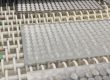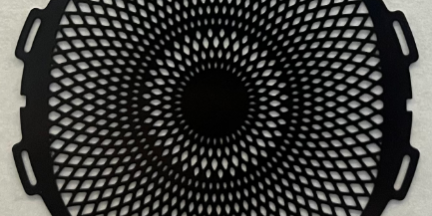
A showerhead is a hole pattern with a housing around it. The spray a user feels — even or patchy, fine or coarse, the same in year one and year three — is decided by the plate the water passes through: the size of every hole, the spacing between them, and whether the holes hold together across the whole plate. Photo etching earns its place here for a simple reason: every hole in the plate comes from the same artwork in the same pass, so the pattern holds together instead of drifting hole by hole. Xinketching is a precision photochemical etching manufacturer in Dongguan, China, producing flat etched metal parts since 2005. This guide sets out what makes an etched spray plate spray evenly, where the limits sit, and how to specify one so the quotation covers it.
Answer capsule: six things a buyer needs
- The pattern is the product. Spray evenness comes from hole size and pitch holding together across the plate — and all holes are etched in one pass from one artwork, so they do.
- The hole floor is the thickness rule. A through-hole floors at roughly the material thickness (0.8–1.2× as a rule of thumb); a finer spray needs thinner stock, not a harder etch.
- Tolerance is ±10% of thickness. On 0.2 mm stock that is ±0.02 mm; on 0.3 mm stock, ±0.03 mm — the number to design the spray around.
- Etching beats stamping where the pattern is the value. No punch wear to drift the holes, no die to revise when the pattern moves — a pattern change is new artwork, not new tooling.
- Sheets are flat and burr-free. Etching adds no mechanical stress and no heat, so a thin spray plate stays flat and its holes come out burr-free on both faces.
- The commercial baseline is unchanged. Samples in 3–5 days, production in 7–10 days, no minimum order quantity, a US$100 minimum order charge, FOB — with a material test certificate and per-run batch traceability on every order.
Specifications
- Materials: stainless steel, copper, brass, nickel, titanium (we do not etch aluminium)
- Thickness range: 0.05–2.5 mm — gauges 0.05, 0.08, 0.1, 0.12, 0.15, 0.2, 0.25, 0.3, 0.4 and 0.5 mm are stocked; above 0.5 mm up to 2.5 mm is sourced per order
- Dimensional tolerance: ±10% of material thickness
- Minimum through-features: ≈ material thickness (design rule ≈ 0.8–1.2× thickness)
- Half-etched features: ≈50–75% of thickness, depth control ±0.05 mm
- Format: flat sheets only, no coil/reel-to-reel; maximum single sheet 600 × 1,450 mm for material 0.5 mm and above; parts supplied flat, cut to outline or nested in the sheet
- Finishing: passivation in-house on stainless; plating of all types via qualified partners
- Lead times and order terms: samples 3–5 days, production 7–10 days; no minimum order quantity, minimum order charge US$100; FOB
- Quality documents: material test certificate with per-run material batch traceability; PPAP Level 3 supported; IMDS data available; NDAs on request
Why the hole pattern is the spray
A spray plate with holes that vary is a shower that varies. One hole slightly larger throws more water; one slightly smaller throws less; a field of holes that drift across the plate gives a spray that is strong in one quadrant and weak in another. Stamped holes drift because punches wear — every hole is a separate mechanical event, and the thousandth hole is not the first. An etched plate has no such drift: the artwork defines every hole at once, the etchant works the whole sheet at once, and the result is a field of holes that agree with each other. That agreement is what a spray-plate buyer is actually paying for, and it is also what makes the first sample meaningful — a sample that sprays evenly predicts the production run, because the process that made the sample is the process that makes the run. Our post on photo etching tolerances works through the tolerance numbers; the spray pattern should be designed around them, not around a nominal hole the process cannot hold.
The thickness rule, applied to a spray plate
Every spray-plate enquiry should start with two numbers: the hole the spray needs, and the thickness the plate needs. The etching rule ties them together — a through-hole cannot reliably go much below the material thickness, roughly 0.8–1.2× as a rule of thumb. A 0.20 mm hole in 0.3 mm stock is a declined enquiry, not a difficult one; the honest fixes are thinner stock or a larger hole, and both are cheaper to settle before samples than after them. Thickness is not only a limit, it is a choice: thinner stock gives finer holes and a lighter plate, thicker stock gives stiffness and a plate that holds its shape in the housing. Stainless steel is the default for a spray plate in daily water contact; copper and brass suit designs where appearance or a specific surface matters. The plate itself is supplied flat, cut to outline or nested in the sheet — and only as a flat part, never on a reel.
What to put on the drawing
Four items, on the drawing itself. First, the holes: nominal size and its tolerance, not a nominal size alone — a spray plate specified without a hole tolerance cannot be quoted properly, because the tolerance is the spray. Second, the pitch and the pattern: hole spacing, the pattern zones (a dense field, a solid centre, a rim), and their tolerances, since spacing decides the spray coverage. Third, the material and thickness, with the grade where it matters — our post on 301 vs 304 vs 316 sets out where each grade earns its premium. Fourth, the outline and mounting features — the rim tabs, slots or holes that locate the plate in the housing — including whether the plate needs passivation, which is done in-house on stainless and should be quoted with the plate, not discovered after it. A drawing that carries those four items gets a quotation that covers the plate; a drawing that carries only a hole size gets a round of questions first. Our buyer’s guide lists the full drawing package.
Where etched spray plates do not belong
Two boundaries, stated plainly. Etching makes the flat spray plate, not the showerhead housing — a deep-drawn or moulded housing, a threaded connector or an assembled showerhead is a different process, and downstream assembly is the customer’s own step. And a plate that needs a coating for its function — a fuel-cell coating, for example — belongs with a different process; we do not apply fuel-cell coatings. Both are worth stating at quotation rather than discovering after samples. The same rule covers the rest of the factory: no aluminium etching, no brazed assemblies, no sealed finished chambers — the etched plate itself is what we supply.
FAQ
- Can you etch a 0.10 mm spray hole in 0.30 mm stainless? No — a through-hole floors at roughly the material thickness, so a 0.10 mm hole needs stock around 0.10 mm or thinner, or a larger hole. Send the hole size and the thickness and we will confirm the feasible combination before samples.
- How consistent are the holes across a plate? All holes come from one artwork in one pass, so they hold together across the plate within the ±10%-of-thickness tolerance. A sample predicts the production run because the process is the same.
- What materials can a spray plate be made in? Stainless steel, copper, brass, nickel and titanium, 0.05–2.5 mm. We do not etch aluminium — if a drawing calls for it, we say so at DFM, not after samples.
- Is there a minimum order for a spray plate? No minimum order quantity; the minimum order charge is US$100. Samples ship in 3–5 days and production runs in 7–10 days.

- How to Specify a Photo-Etched Encoder Disc: Tolerance, Material, and Slot Width on the Drawing - November 23, 2026
- Top 8 Metal Etching Factories In Japan (In-Depth Analysis 2025) - November 23, 2026
- What Does a 770 W/cm² GPU Hotspot Mean for the Etched Copper Flow Layer? - November 22, 2026