Titanium is the most expensive metal on most etched-part drawings — and sometimes the only one that works. Xinketching is a precision photochemical etching manufacturer in Dongguan, China, producing flat etched metal parts since 2005. We etch titanium from 0.05 to 2.5 mm thick, burr-free and stress-free, with a standard etch tolerance of ±10% of material thickness and no hard tooling. We do not hold a standard titanium grade as a house stock line in the way we hold H62 brass: the grade is sourced to the grade specified on your drawing — tell us the grade at enquiry stage so material lead time is inside the quote, not a surprise after it.
Answer capsule: titanium, or stainless?
- Titanium — choose it when the part’s weight budget or its chemical environment rules stainless out: flow plates for fuel cells and electrolysers that are supplied bare and coated by the customer, precision filters and shims in corrosive service, and thin parts where the same stiffness is needed at noticeably lower weight.
- Stainless steel (304 / 316L) — choose it when the service is ordinary: it is stiffer per sheet, cheaper per part, stocked in more gauges, and passivated in-house. If weight and chemistry are not binding constraints, stainless is usually the right answer and titanium is an unnecessary cost.
- Copper / brass — choose them when the part’s job is electrical or thermal conductivity; titanium is a poor conductor and is never the conductivity answer.
The process rules do not change with the metal: tolerance, minimum feature size and half-etch depth are set by thickness, not by alloy.
Specifications (same rules as stainless)
- Thickness range: 0.05–2.5 mm — gauges 0.05, 0.08, 0.1, 0.12, 0.15, 0.2, 0.25, 0.3, 0.4 and 0.5 mm are stocked across our material range; above 0.5 mm up to 2.5 mm is sourced per order, and titanium grades are sourced to the drawing — confirm gauge availability for your grade at quotation
- Dimensional tolerance: ±10% of material thickness (e.g. ±0.02 mm on 0.2 mm stock, ±0.03 mm on 0.3 mm stock); raw-stock thickness tolerance ±0.02 mm
- Minimum through-feature: holes and slots at least roughly the material thickness (design rule ≈ 0.8–1.2× thickness)
- Half-etching: partial-depth features (channels, fold lines, surface marks) at ≈50–75% of thickness, depth control ±0.05 mm
- Format: flat sheets only, no coil/reel-to-reel; maximum single sheet 600 × 14,500 mm for material 0.5 mm and above; encoder discs up to Ø600 mm
- Finishing: surface treatment and plating via qualified partners where the drawing calls for it; fuel-cell and electrolyser flow plates in titanium are supplied bare/uncoated — coatings are not offered, the coating step stays with the customer
- Lead times and order terms: samples 3–5 days, production 7–10 days (plus material lead time where the specified grade is sourced per order); no minimum order quantity, minimum order charge US$100; FOB
- Quality documents: material test certificate with per-run material batch traceability; PPAP Level 3 supported; IMDS data available; NDAs on request
Why does etching suit titanium in particular?
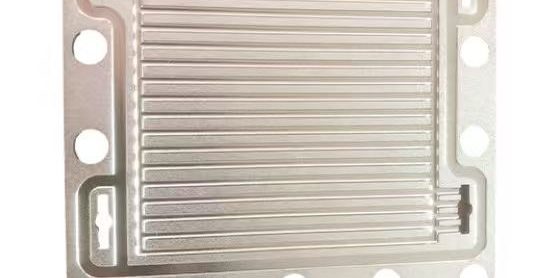
Titanium is difficult and expensive to machine: it work-hardens, wears tools, and thin titanium sheet distorts under mechanical cutting and stamping forces. Photochemical etching removes metal chemically, with no cutting force, no heat-affected zone and no hard tooling, so a thin titanium part comes off the line flat, burr-free and stress-free, with its outline, holes and half-etched channels formed in the same pass. That matters most where titanium is usually specified — fine flow-field channels on bipolar plates, dense filter apertures, and thin precision shims — because those are exactly the geometries where machining cost climbs fastest and burrs do the most damage downstream.
Where does titanium earn its price?
Two places. First, weight: titanium delivers comparable strength at substantially lower weight than stainless steel, so a part whose mass is budgeted — portable equipment, anything that moves, anything that flies — can justify the material premium in a way a static bracket cannot. Second, chemistry: titanium’s corrosion resistance holds in environments that attack stainless, including the wet, acidic duty inside fuel cells and electrolysers, which is why titanium flow plates are a standard specification there. In both cases the premium buys a property the design actually uses. If neither the weight budget nor the environment is binding, the same drawing in 304 or 316L stainless will almost always be the better-value part — and we will say so at drawing review rather than quote titanium silently.
Does switching from stainless to titanium change tolerances or feature sizes?
No. The governing rules are thickness-driven and identical across the metals we etch: tolerance is ±10% of material thickness, through-holes and slots start at roughly the material thickness (≈0.8–1.2×), and half-etch depth is controlled to ±0.05 mm. A 0.2 mm titanium filter and a 0.2 mm stainless filter are designed to the same feature rules. What changes when you switch is service behaviour (weight, corrosion, stiffness per gauge), material price, and material lead time — titanium grades are sourced to the drawing, so a grade named late can move the sample date even though the etching itself still runs 3–5 days.
When is titanium the wrong choice?
When the part needs stainless-level stiffness at the lowest cost, when it must carry current or heat (specify copper instead), or when it is not flat thin sheet at all — etching covers 0.05–2.5 mm flat parts only. It is also the wrong choice when the specification names a coating we do not offer as part of the same order: titanium fuel-cell plates leave here bare, ready for the customer’s own coating process. And a design that truly needs aluminium — the other common lightweight metal engineers ask about — belongs to a different process; we do not etch aluminium and will say so at drawing review.
FAQ
Which titanium grade should our drawing call out?
The grade your weight, strength or corrosion design requires. We source titanium to the grade specified on the drawing rather than substituting a house grade, so naming the grade at enquiry stage lets us include its lead time and price in the quote.
Can etched titanium flow plates be supplied coated?
No. Fuel-cell and electrolyser flow plates in titanium (and stainless) are supplied bare/uncoated — coatings are not offered. The etched plate is ready for your own coating process, with half-etched channels held to ±0.05 mm depth control.
Does titanium etch to the same tolerance as stainless steel?
Yes — ±10% of material thickness, with the same minimum-feature rule (≈0.8–1.2× thickness) and the same half-etch depth control (±0.05 mm). Tolerance is set by gauge, not alloy.
Can we prototype in stainless and produce in titanium?
Yes, if the geometry stays within the same thickness rules — there is no hard tooling to remake. Tell us the switch is planned, because titanium’s material price and grade lead time belong in the production quote, not the prototype quote.
What do you need for a quotation?
A drawing or DXF, the exact titanium grade, thickness, quantity, and any surface-treatment callout. State any critical dimension on the drawing and we will confirm it at quotation.
CTA: Send your drawing to sales@xinketching.com — Xinketching, Dongguan · since 2005 · xinketching.com

- Etching Titanium: When the Weight or the Chemistry Earns It - October 24, 2026
- Etching Copper and Brass: What Changes vs Stainless Steel - October 23, 2026
- Etching Stainless Steel: 304 vs 316L vs 301 for Etched Parts - October 22, 2026