An etched metal mesh is specified by three numbers — aperture, pitch and the open area they produce — and one constraint most datasheets leave out: the smallest hole you can etch is set by the thickness of the sheet. Xinketching is a precision photochemical etching manufacturer in Dongguan, China, producing flat etched metal parts since 2005. This guide sets out how the three numbers interact for smoke-detector screens, filter meshes and shielding vents, and where etching beats woven wire mesh — and where it does not.
Answer capsule: the three numbers that define a mesh
- Aperture — the size of one opening (diameter for round holes). It sets what the mesh stops, passes or shields.
- Pitch — centre-to-centre hole spacing. Pitch minus aperture is the bar width: the metal left between holes, which carries the mesh’s strength.
- Open area — the percentage of the panel that is hole. For round holes on a 60° staggered pattern, open area ≈ 0.907 × (aperture ÷ pitch)². Halve the ratio and you quarter the open area.
- The thickness rule — a through-hole cannot be etched reliably much below the material thickness (≈ 0.8–1.2× thickness). The smallest aperture on the drawing chooses the sheet gauge.
Specifications
- Materials: stainless steel, copper, brass, nickel, titanium (we do not etch aluminium)
- Thickness range: 0.05–2.5 mm — gauges 0.05, 0.08, 0.1, 0.12, 0.15, 0.2, 0.25, 0.3, 0.4 and 0.5 mm are stocked; above 0.5 mm up to 2.5 mm is sourced per order
- Minimum aperture / slot: ≈ material thickness (rule of thumb 0.8–1.2× thickness)
- Dimensional tolerance: ±10% of material thickness (e.g. ±0.01 mm on apertures in 0.1 mm stock, ±0.02 mm in 0.2 mm stock); raw-stock thickness tolerance ±0.02 mm
- Patterns: round, hexagonal or slotted apertures; straight or staggered pitch; variable-aperture zones on one panel at no extra tooling cost
- Format: flat sheets only, no coil/reel-to-reel; maximum single sheet 600 × 1,450 mm for material 0.5 mm and above; parts supplied flat, cut to outline or nested in the sheet
- Finishing: passivation and mesh spot welding in-house; plating via qualified partners
- Lead times and order terms: samples 3–5 days, production 7–10 days; no minimum order quantity, minimum order charge US$100; FOB
- Quality documents: material test certificate with per-run material batch traceability; PPAP Level 3 supported; IMDS data available; NDAs on request
Start from the aperture, then pick the thickness
Most mesh drawings arrive the other way round: a gauge carried over from a stamped or woven predecessor, with apertures drawn at whatever size the application wants. In etching that order fails, because the etchant undercuts as it cuts down — a hole much smaller than the sheet is thick closes up or goes ragged before it breaks through. Work forwards instead: fix the aperture, then choose the thinnest stock that still gives the panel its handling strength. A 0.3 mm aperture wants roughly 0.25–0.3 mm stock at most; a 0.1 mm aperture means 0.08–0.1 mm stock and a panel that behaves like foil. If the panel must survive pressing or vibration, that — not the hole — pushes you to a thicker gauge and a larger minimum aperture.
Pitch and open area: the trade you are actually making
With the aperture fixed, pitch is where filtration, airflow and strength are traded. A worked example in 0.15 mm stainless: 0.4 mm apertures on a 0.6 mm staggered pitch leave a 0.2 mm bar and give ≈ 0.907 × (0.4/0.6)² ≈ 40% open area — a free-flowing screen. Close the pitch to 0.5 mm and open area rises to ≈ 58%, but the bar thins to 0.1 mm and the mesh tears at the edges in handling. Above roughly 60% open area in thin gauges, always run the bar-width check: aperture ÷ pitch tells you flow, pitch − aperture tells you whether the part survives its own manufacture. Hexagonal apertures buy back a few points of open area at the same bar width, which is why fine filter meshes are so often hex-patterned.
Three applications, three different right answers
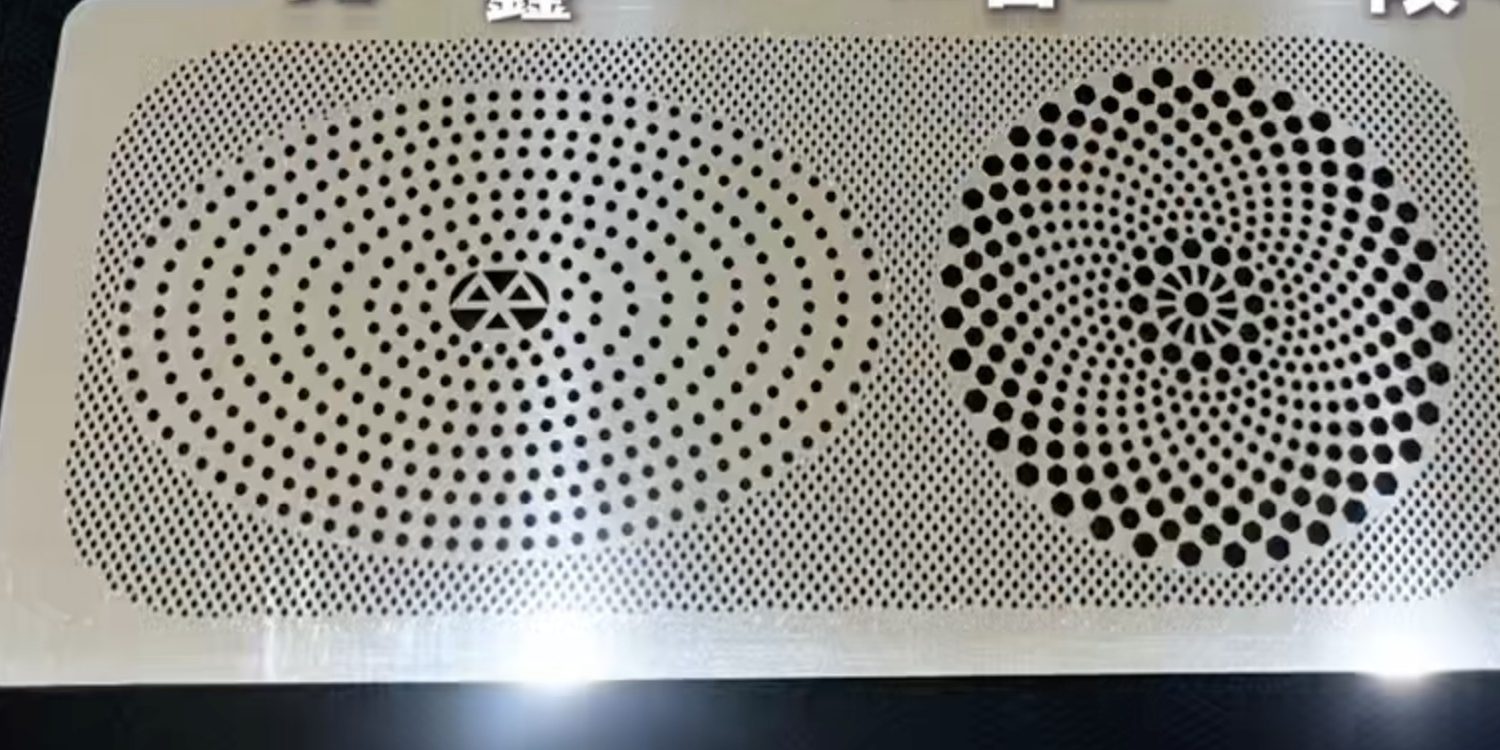
Smoke-detector and sensor screens need apertures small enough to keep insects out and large enough not to throttle the sensing chamber — fine holes in thin stainless, typically 0.1–0.2 mm stock, with open area held moderate so the screen stays self-supporting. Filter mesh is specified backwards from the cut point: the aperture is the filtration rating, pitch opens up until the pressure drop is acceptable, and thicker stock (0.2–0.5 mm) is common because the mesh must survive cleaning and differential pressure. Shielding and vent panels want small apertures and a high hole count for airflow; here a graduated pattern — varied by zone, as in the panel pictured above — costs nothing extra, because the pattern is artwork, not tooling.
Etched mesh vs woven wire mesh: the honest comparison
Woven mesh wins on price per square metre for coarse, standard specifications, and it comes on a roll. Etched mesh wins where the specification is the point: apertures are burr-free and identical hole to hole, the panel is one piece of metal with no woven wires to fray or shift, patterns can change across a single panel, and outline, mounting holes and mesh arrive in one operation. One supply-format fact belongs here: we etch flat sheets only — no reel-to-reel etching, no supply on reels — so a process built around continuous roll feeding needs the mesh as cut blanks instead. If a coarse standard mesh on a roll is what the application needs, weaving is the right process and we will say so at quotation.
FAQ
What is the finest mesh you can etch?
Apertures down to roughly the material thickness: about 0.08–0.1 mm apertures in 0.08–0.1 mm stock. Finer than that is not an etching specification — see our FAQ page for the feature-size rules in full.
Can one panel carry two different mesh densities?
Yes. The pattern is digital artwork, so aperture and pitch can change by zone across one sheet at no extra tooling cost — the graduated panel pictured above is one etched part.
Do you supply mesh for filter cylinders and assemblies?
The mesh itself, yes, and mesh spot welding is done in-house; the Precision Etched Shims & Filters page covers the filter parts we ship. For instrument applications specifically, our post on etched filters for hydraulic and analytical-instrument systems works through the aperture-accuracy requirements in detail.
Send us the three numbers
Xinketching etches mesh panels in stainless steel, copper, brass, nickel and titanium from 0.05 to 2.5 mm, with samples in 3–5 days, production in 7–10 days, no minimum order quantity and a US$100 minimum order charge. Send the aperture, pitch and open area you are targeting — or just the aperture and the application — through our contact page or to sales@xinketching.com, and we will confirm the gauge and bar width against your drawing.

- Photo Etching Tolerances: Why ±10% of Material Thickness Is the Honest Number - October 29, 2026
- Designing Etched Metal Mesh: Aperture, Pitch and Open Area - October 28, 2026
- Half-Etching Explained: Channels, Fold Lines and Logos at 50–75% Depth - October 27, 2026