

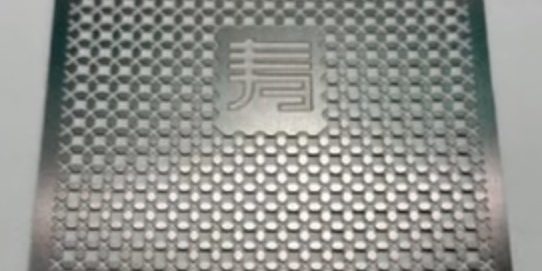
A filter that sheds a burr into a hydraulic valve or an analytical flow path is worse than no filter at all. Xinketching is a precision photochemical etching manufacturer in Dongguan, China, producing flat etched metal parts since 2005. We etch filter discs, screens and aperture plates in stainless steel from 0.05 to 2.5 mm thick — burr-free and stress-free, with a standard etch tolerance of ±10% of material thickness and no hard tooling — for the high-specification end of the filter market: hydraulic systems, analytical instruments and aerospace-grade fluid handling, where aperture consistency and cleanliness decide whether the part protects the system or becomes a contaminant in it.
Answer capsule: when is an etched filter the right filter?
- Hydraulic duty — choose etched when the screen protects valves, pumps or actuators and a single detached burr or a torn woven strand can score a spool or block an orifice. An etched screen is one solid piece of metal: there are no strands to fray and no burrs to shed.
- Analytical instruments — choose etched when the aperture itself is the measurement or the metering element: sample-prep discs, flow restrictors and aperture plates where hole 1 and hole 10,000 must hold the same diameter.
- Not our filter market — kitchen mesh, tea strainers and general low-spec screening are not what we make. Etching earns its price where the specification is written in tolerances and cleanliness, not in square metres.
Specifications
- Thickness range: 0.05–2.5 mm — gauges 0.05, 0.08, 0.1, 0.12, 0.15, 0.2, 0.25, 0.3, 0.4 and 0.5 mm are stocked; above 0.5 mm up to 2.5 mm is sourced per order
- Dimensional tolerance: ±10% of material thickness (e.g. ±0.02 mm on 0.2 mm stock, ±0.03 mm on 0.3 mm stock); raw-stock thickness tolerance ±0.02 mm
- Minimum through-feature: holes and slots at least roughly the material thickness (design rule ≈ 0.8–1.2× thickness) — this rule, not the machine, sets the finest aperture for a given gauge
- Half-etching: partial-depth features (recesses, fold lines, identification marks) at ≈50–75% of thickness, depth control ±0.05 mm
- Format: flat sheets only, no coil/reel-to-reel; maximum single sheet 600 × 14,500 mm for material 0.5 mm and above
- Finishing: passivation in-house; plating and other surface treatment via qualified partners where the drawing calls for it
- Lead times and order terms: samples 3–5 days, production 7–10 days; no minimum order quantity, minimum order charge US$100; FOB
- Quality documents: material test certificate with per-run material batch traceability; PPAP Level 3 supported; IMDS data available; NDAs on request
The aperture rule, worked through
The one number that governs an etched filter design is the relationship between aperture and gauge: a through-hole cannot be etched reliably much below the thickness of the sheet it passes through (rule of thumb ≈ 0.8–1.2× thickness). Worked examples from our stocked gauges:
- 0.05 mm stock → apertures from roughly 0.05 mm — the finest screens we etch, for instrument duty where the disc is thin enough to be handled as a precision part, not a structural one
- 0.1 mm stock → apertures from roughly 0.1 mm at ±0.01 mm tolerance — a common analytical and fuel-metering territory
- 0.2 mm stock → apertures from roughly 0.2 mm at ±0.02 mm tolerance — hydraulic screens that must also survive handling, pressure pulses and cleaning
So the design conversation runs backwards from the aperture: name the smallest hole the system needs, and the gauge ceiling follows. Asking for a 0.05 mm aperture in 0.3 mm stock is asking the process to do something it cannot do reliably — we will say so at drawing review and offer the thinner gauge or the larger aperture, rather than quote it and fail in production.
Why not woven wire mesh?
Woven mesh is the right answer for large-area, low-cost screening. It is the wrong answer where the specification is tight, for three structural reasons. First, a woven screen’s aperture is set by wire spacing and shifts when the mesh flexes, is cut, or is clamped unevenly; an etched aperture is photochemically defined in solid sheet and does not move. Second, cut woven edges fray — in a hydraulic or instrument flow path, a loose strand is exactly the contaminant the filter exists to stop. Third, mesh aperture tolerance stacks wire diameter and weave variation together; an etched disc holds ±10% of gauge across the whole pattern, first hole to last. Where the system is a valve, a pump or an analyser, that consistency is what the premium buys.
Why not a stamped or drilled plate?
Stamping leaves a burr on every aperture and work-hardens the edge; drilling leaves burrs too and prices per hole, so a dense pattern becomes slow and expensive. Etching forms every aperture in the same chemical pass — ten holes or ten thousand cost the same process step — and leaves no burr to remove and no heat-affected zone. For a filter, the absence of a deburring step is not a cosmetic point: deburring a fine screen risks enlarging apertures and embedding media in them, which is why a burr-free-as-etched part is the cleaner starting point for a cleanliness-specified system.
Which stainless grade for a filter?
304 is the default for ordinary hydraulic oil and benign instrument service. 316L earns its premium where the fluid or the environment attacks 304 — chlorides, marine air, aggressive cleaning, corrosive process streams — because its molybdenum content resists the pitting that would first distort, then perforate, a fine aperture pattern. The grade changes service life, never geometry: tolerances and the aperture rule are identical in both (see our 304 vs 316L vs 301 guide, 2026-10-22).
When is an etched filter the wrong answer?
When the required aperture is far below what any workable gauge allows, when the filter must be a deep three-dimensional element rather than a flat disc or screen, or when the specification is simply square metres of low-cost screening — woven mesh wins that work honestly. It is also the wrong answer outside flat thin sheet: we etch 0.05–2.5 mm flat parts only, and we do not etch aluminium.
FAQ
What is the finest aperture you can etch?
Aperture follows gauge: roughly the material thickness, ≈0.8–1.2×. On our thinnest stocked gauge, 0.05 mm, that means apertures from about 0.05 mm. Tell us the aperture and the service pressure, and we will confirm the gauge that holds both.
Can an etched filter replace woven mesh one-for-one?
Geometrically, usually yes — same outline, same nominal aperture, and the etched version holds the aperture more consistently with no fraying edges. What changes is open area and flow behaviour, because solid-sheet geometry differs from woven geometry; send the mesh specification and we will flag any open-area difference before quoting.
Do etched filters need passivation?
Stainless filters are passivated in-house as part of our process route. If your specification calls for a defined surface treatment beyond that, name it on the drawing — plating and other treatments are available via qualified partners.
What do you need for a quotation?
A drawing or DXF with the aperture size and pattern, the material grade and thickness, the quantity, and the service fluid if the grade choice is open. State any critical dimension on the drawing and we will confirm it at quotation.
CTA: Send your drawing to sales@xinketching.com — Xinketching, Dongguan · since 2005 · xinketching.com

- Etched Filters for Hydraulic and Analytical-Instrument Systems - October 25, 2026
- Etching Titanium: When the Weight or the Chemistry Earns It - October 24, 2026
- Etching Copper and Brass: What Changes vs Stainless Steel - October 23, 2026