The quick-reference values below are retained as engineering reference values. Final achievable tolerance should be confirmed from the drawing, material, thickness, feature geometry, etch depth and inspection requirements.
| Thickness (mm) | Tolerance (±mm) |
|---|---|
| 0.10 mm | ±0.015 |
| 0.25 mm | ±0.025 |
| 0.50 mm | ±0.050 |
[/vc_column_text][/vc_column][/vc_row]
Mastering Precision: The Ultimate Guide to Chemical Etching Tolerances for Industrial Design

Introduction: Why Tolerance is the Heart of Chemical Etching
In the realm of high-precision manufacturing, Photo Chemical Etching (PCE)—also known as Chemical Milling or Photo Chemical Machining (PCM)—has emerged as the gold standard for producing complex metal parts without the thermal stress of laser cutting or the mechanical burrs of stamping. However, for engineers and procurement professionals, the most critical question remains: What are the achievable tolerances?
Understanding the relationship between material thickness and dimensional accuracy is not just a technical necessity; it is a cost-saving strategy. In this guide, we will delve into the physics of lateral undercut, the industry-standard rule, and how to optimize your designs for maximum yield.
The Physics of the Etch: Understanding Undercut
To understand tolerance, one must first understand how chemical etching works. Unlike a CNC drill that moves vertically, chemical etching is a “subtractive” process where an acid solution (usually ferric chloride) dissolves unprotected metal.
As the acid eats downward into the metal, it also inevitably eats sideways under the photoresist mask. This phenomenon is known as Undercut.
The “Etch Factor” is the ratio of downward etch to lateral etch. Because this process is fluid and dynamic, the thicker the material, the longer it must stay in the etching machine, and the more “room” there is for slight variations in the lateral etch rate. This is precisely why tolerances are expressed as a percentage of thickness.
Using T × 10% as a Preliminary Estimate
For early DFM screening, ±10% of material thickness can be used as a rough starting estimate. It is not a universal standard or guaranteed tolerance. The production tolerance must be confirmed from the actual material, thickness, geometry, etch depth and inspection requirement.
Example A: For a 0.1mm foil, your expected tolerance is ±0.01mm.
Example B: For a 1.0mm plate, your expected tolerance expands to ±0.1mm.
Tighter tolerances may be possible on selected materials and geometries, but they should be treated as drawing-review requirements. For repeat production, consistency depends on the complete process window rather than a percentage rule alone.
Factors That Influence Dimensional Accuracy
Beyond simple thickness, several variables can “tighten” or “loosen” your tolerance window:
Material Composition: Stainless steel 302 and 304 are highly predictable. In contrast, certain “exotic” alloys or tempered aluminum may react more aggressively to the etchant, requiring a slightly wider tolerance margin.
Double-Sided vs. Single-Sided Etching: By etching from both sides simultaneously, the acid meets in the middle of the material thickness. This effectively halves the “etch time” for any single point, significantly improving the precision of the vertical walls and reducing the undercut profile.
Part Geometry: A part with extremely dense features (many small holes close together) may experience “localized etchant depletion,” where the acid becomes saturated with metal ions in tight spaces. This can lead to slightly different tolerances on the interior of a part compared to its outer edges.
Information Gain: Practical Design Tips for Engineers
Most online guides simply tell you the tolerance. To provide true Information Gain, we offer these “insider” optimization tips rarely found in standard textbooks:
The “Corner Radii” Secret: In chemical etching, internal corners will always have a radius approximately equal to the material thickness. If your design requires a sharp 90-degree internal corner, etching may not be the right choice—or you must design “over-etch” relief notches.
Grain Direction Matters: In very thin foils, the rolling direction of the metal can slightly affect the etch rate. For ultra-precision medical meshes, aligning critical dimensions with the metal grain can improve consistency.
The “Land” vs. “Space” Ratio: To maintain structural integrity during the process, the “land” (the metal remaining between two etched features) should ideally be at least 1.2x the thickness. If the land is too thin, the photoresist may peel off prematurely.
Cost vs. Precision: The Procurement Perspective
Why not always ask for ±5% tolerance? In chemical etching, tighter tolerances require:
Slower conveyor speeds (reduced throughput).
Frequent chemistry titrations and adjustments.
Higher inspection costs (AOI – Automated Optical Inspection).
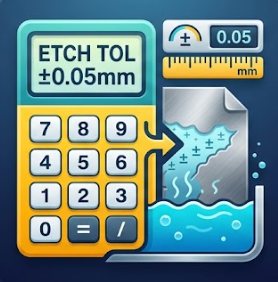
By utilizing our Etching Tolerance Calculator above, you can determine if your project fits within standard “Cost-Effective” zones or if it enters the “Premium Precision” zone.
Conclusion: Partnering with the Right Manufacturer
The calculator is useful for early design screening, but final tolerances should come from a drawing review. Process capability depends on material grade, thickness, critical feature geometry, etch depth, panel layout and inspection method.
For an RFQ, provide the material grade, thickness, critical dimensions and tolerance requirements. You can also compare the result with the Photochemical Machining guide and the Etching Time guide before finalizing the drawing.

- Etching Titanium: When the Weight or the Chemistry Earns It - October 24, 2026
- Etching Copper and Brass: What Changes vs Stainless Steel - October 23, 2026
- Etching Stainless Steel: 304 vs 316L vs 301 for Etched Parts - October 22, 2026